Hi Sasha! I really loved how you emphasized how important the shift away from “one-size-fits-all” is when you broke down the Universal Design for Learning (UDL). Your point about agency is so valuable: UDL is not just about accessibility, but about empowering students to take ownership of their learning.
It’s interesting that you prefer synchronous online classes, I’m the exact opposite. I think this goes to show how important it is to have options, so learners can choose what sort of class works best for them. I really like your suggestion of blending the two approaches to focus on flexibility AND connection, and I think that would be a strong idea that benefits all parties.
Your ideas for increasing interaction when teaching online were fantastic. Collaborative and playful elements like Kahoot not only help with learning, but also build community, which is something that online spaces tend to lack. In sum, your blog post really highlighted why inclusive design matters: not only to support students with barriers, but to create a better learning environment for everyone!
Hi Max! I love how you broke down the three UDL principles and connected them to your own educational experiences. Your tutoring example really shows how Multiple Means of Representation can transform a students confidence and comprehension. I absolutely loved your story about the wig too. It showed that inclusion doesn’t always have to be elaborate and small moments can have the most meaningful impact.
Your breakdown of synchronous vs asynchronous learning was super clear, and I enjoyed reading about the hybrid model you had in your EPHE course. It goes to show how these two approaches can support each other, providing structure with flexibility, designed with accessibility in mind.
In sum, your blog post highlighted the idea that UDL is more than just a framework, but a mindset too, preaching belonging and inclusivity.
Hi Sophia! I really loved the way you weaved together UDL, Inclusive Learning Design, and Synchronous vs Asynchronous learning. I especially liked how you acknowledged the global evolution of UDL, illustrating how this idea grows beyond a western context. As a dancer myself, I absolutely loved the tortoise vs hare dance and I think this was a fantastic contribution to your talking points.
It’s so true than many of us only recognized the strength of asynchronous formats once we were immersed in them during the Covid-19 pandemic. I loved hearing how anonymous collaboration increased student voice in your Psychology class. This really demonstrates how digital tools can make learning feel safer in a non-judgmental environment. Overall, this post really highlighted how, when educators design with inclusion in mind, every student becomes more likely to succeed.
As hit alt-rock band, Twenty One Pilots, says, “Intentions are everything.”
This line has its place in the classroom, as effective learning design stems from intentionality. The best learning spaces are built with diverse learners in mind from the start, instead of continuously retrofitting design with each student. This idea of intentionality sits at the forefront of inclusive, engaging, and effective design in educational practice.
Universal Design for Learning is a concept that has come up in every single education class I have taken at UVic. UDL is the idea that learner diversity is the norm, rather than the exception. Every student comes into the classroom with a unique set of skills, needs, experiences, and worldview, so designing with this in mind from the very beginning ensures that no one is left behind.
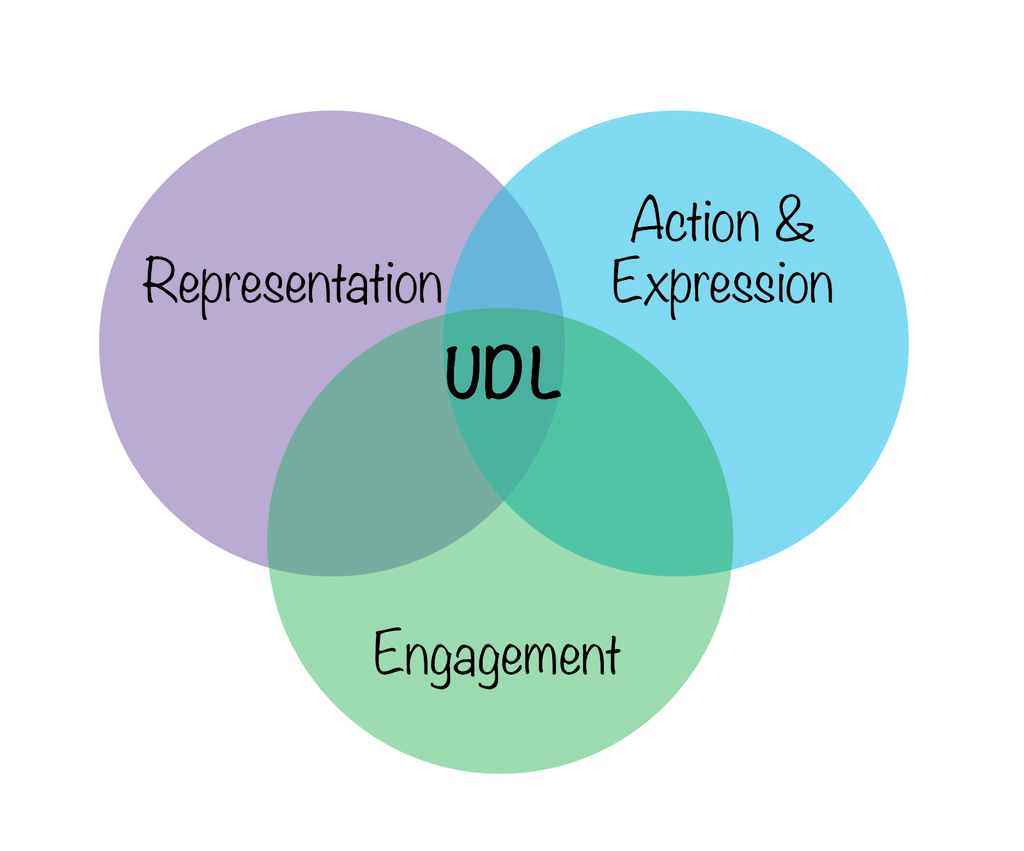
UDL has three principles:
Multiple Means of Engagement – WHY
Options for: recruiting interest, sustaining effort and persistence, and self-regulation
Multiple Means of Representation – WHAT
Options for: perception, language and symbols, and comprehension
Multiple Means of Action and Expression – HOW
Options for: physical action, expression and communication, and executive functions
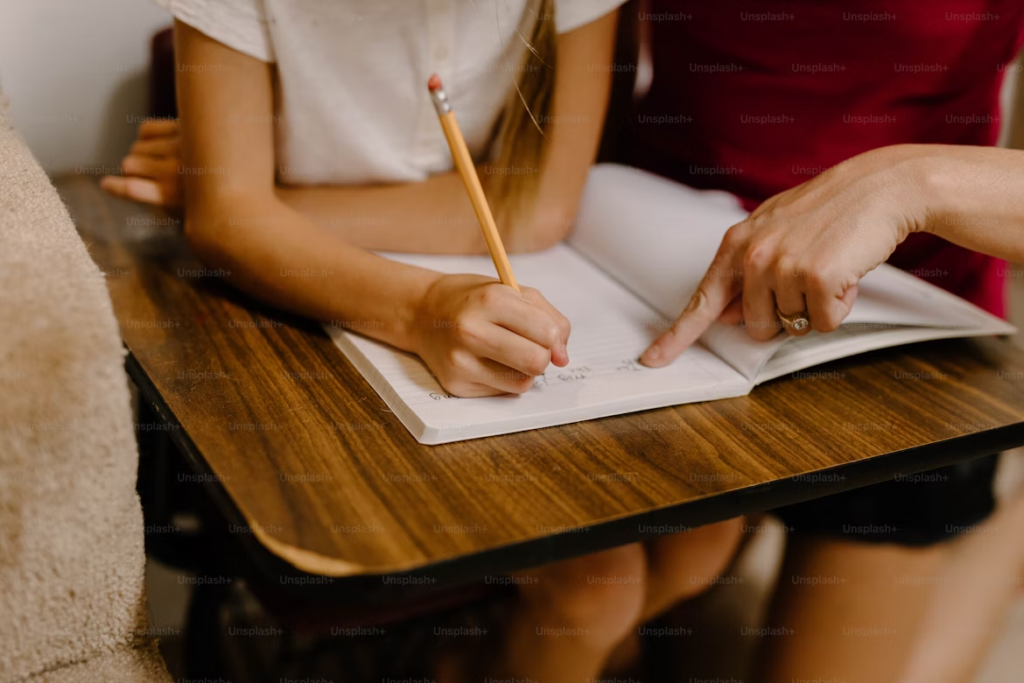
One way I’ve used UDL is in my Link2Practice. I was in a Grade 4/5 class and we had two students who struggled with writing. When planning for English Language Arts assignments, I used UDL principles to value their diverse ways of showcasing their understanding. For one student, he struggled with the actual printing part of writing, so I had him type up assignments for ELA. The second student struggled with the connection between her thoughts and forming sentences, so I had her say her ideas orally while I scribed for her. By allowing learners to feel seen in how they can demonstrate their learning, they are far more likely to feel motivated and succeed.
Inclusive Learning Design
Inclusive Learning Design builds off of the concepts of UDL by recognizing that inclusion is not just about accessibility, but also representation. The importance of representation is something I heard about a lot while I was growing up, but what that actually means didn’t click until I was much older. When I was younger, I remember watching TV shows and movies because they had a singular, non-main character who was queer. I would watch this media for that background character, for that semblance of queerness. When I reflected on this as a teenager, the importance of representation clicked for me. I was a queer person looking for other queer people in the media I was watching, craving that relatability that every other white girl had.
I think I’ve seen Glee (it its entirety) more times than I have fingers
The idea of representation in the classroom is so important, and can be integrated to allow students to feel valid in their identities and like they belong, by:
Using diverse media/authors
Offer culturally-responsive examples
Ensure students see themselves in the materials provided
Synchronous and Asynchronous Learning
Both synchronous (real-time) and asynchronous (not-real-time) learning have their own benefits. Synchronous classes build opportunity for connection and a chance to correct misconceptions immediately, while asynchronous classes offer a more accessible learning space and time for reflection. To reap the benefits, educators can combine these, enhancing inclusion for students with busy schedules and differing learning speeds by offering multiple ways to participate.
My experience with asynchronous learning began alongside many others, during the Covid-19 Pandemic. My classes went fully online when I was in Grade 10, and I found that I procrastinated all of my work until the very last two days, when I spent 48 hours doing a semester worth of assignments. In High School, I figured asynchronous learning worked better for me because it had hard deadlines.
What I spent my time doing in 2020, instead of my classes
In University, I began commuting to school, 1.5h each way. With set 8:30am classes each morning and no flexibility, I found that synchronous classes were my downfall. I work every night, so at most I get about 6 hours of sleep, because all my time goes into commuting rather that learning. Asynchronous classes work so much better for me, because I can put time into learning, doing the work, and being engaged (rather than overtired, but in class) over just commuting back and forth.
So we get this interesting sort of juxtaposition between my experiences with asynchronous classes. When looking back, what I think it really boils down to is design. My Covid classes were designed to be synchronous, so they felt unengaging and unmotivating when taken asynchronously, while my University classes were asynchronous by design, and thus feel educating and significant
Principles of Effective Online Education
In order for online learning to be meaningful and effective, it must be clear, consistent, and connective. Well-designed online environments should be just as structured as they are flexible, by aligning assignments and assessments clearly with learning outcomes. By having criteria and goals accessible, students can focus on learning rather than unveiling expectations.
Including accessible features like captioned videos and multimodal instructions makes learning more accessible for everyone. One of my biggest grievances with assigned videos in classes is when they lack captions. I find that I remember topics much better when I’m reading captions rather than just listening to a video, because I have to more actively participate in my own learning. As well, in asynchronous courses, it’s much easier to screenshot captions for later than rewriting everything currently being said.
Benefits of captions:
Assist hearing-impaired
Benefit learners multimodally
Support ESL students
This goes to show the impact of inclusive education, and the reason that there is no “average student,” because accessibility benefits everyone.
When educating online, presence is everything and interaction is priceless. This can be seen as having instructors who are actively engaged in the learning experience, whether it’s responding to discussions, returning work with feedback in a timely manner, or sharing lived experiences. This presence isn’t about availability, but rather being intentional with connection.
Even when asynchronous, educators can design an engaging learning space by ensuring it includes all three modes of interaction:
Student-Content (connecting with material)
Student-Student (collaboration)
Student-Teacher (guidance and feedback)
Most important when learning asynchronously (and often shoved on the backburner) is the collaborative practices of learning. By having students peer review, discuss together, and work in group projects, learning becomes a community experience.
Meaningful presence and interaction foster trust in the learning process. Trust invites risk-taking, pushing past comfort zones, and growing. Through this, we get an authentic and significant learning experience.
Conclusion
Teaching is not about having a perfect plan, but it is about having a responsive one. Learning design is a circular process which must be continuously revisited and refined. Through processes like UDL and Inclusive Learning Design, we can make intentional and meaningful educational spaces, whether that means coming together in the classroom or working independently in an online space.
Hi Sasha! I really enjoyed reading your thoughts on this module and your explanation of Backward Design and Understanding by Design, especially how you connected it to Jennifer Gonzalez’s Cult of Pedagogy podcast! You really hammered in that teaching is most effective when we start with the why and plan with a purpose.
I loved reading your reflection on inquiry-based and project-based learning. Hearing that, while you didn’t connect with the class novel, you really got into the novel-based trivia game is so awesome and goes to show that the design methods we are learning really make a difference when put into practice. I would’ve loved for you to go deeper into what assessment looks like for inquiry and project-based learning. While a class-made rubric is great for summative assessment, I wonder how self-reflection and formative assessment can be incorporated.
This blog post was engaging, succinct, and does a great job outlining different design methods and how they are interconnected. I can’t wait to read your next one!
Hi Max! I really enjoyed reading your blog post, especially how reflective and personal your thoughts on these design theories were! Connecting the Understanding by Design model with your lived experience this term really captures the key point of design models like this, and how it allows both teachers and learners alike to plan with intention.
Your example of the carnival game you and your out-of-school-care kids created is such a fun and authentic use of Design Thinking in action. I loved how you laid out your process, walking us (as in the readers) through the stages, showing how this framework really works in teaching. It’s great to see how empathy can lead to more meaningful engagement and, sometimes, even new carnival games!
Your learning-by-doing mountain biking example was such a great anecdote for experiential learning. It ties in so well with the theme of your post and really shows that true growth comes from curiosity and reflection, not rote memorization.
My experience with asynchronous learning began alongside many others, during the Covid-19 Pandemic. My classes went fully online when I was in Grade 10, and I found that I procrastinated all of the work until the very last two days, when I spent 48 hours doing a semester worth of work. In High School, I found synchronous learning worked better for me because it had hard deadlines.
In University, I began commuting to school, 1.5h each way. With set 8:30am classes each morning and no flexibility, I found that synchronous classes were my downfall. I work every night, so at most I get about 6 hours of sleep, because all my time goes into commuting rather that learning. Asynchronous classes worked so much better for me, because I could put time into learning, doing the work, and being engaged (rather than tired) over just commuting back and forth.
So we get this interesting sort of juxtaposition between my experiences with asynchronous classes. When looking back, what I think it really boils down to is design. My Covid classes were designed to by synchronous, so they felt unengaging and unmotivating when taken asynchronously, while my University classes were asynchronous by design.
The difference between classes that you do and forget about, and classes that stick with you and shape how you think, is almost entirely based on instructional design. Concepts like backward design, understanding by design, design thinking, learning outcomes, and project-based learning are more than just buzzwords, but tools that explain why some learning experiences felt meaningful, while others felt like busy work.
Backward Design and Understanding by Design
The idea of Understanding by Design is a educational framework which operates in three stages:
Determine Evidence – assessments to show learning (performance tasks, projects, tests, etc.)
Plan Learning Experiences & Instruction – align activities to outcomes and evidence
Basically, start at the end and end at the start, or, more eloquently, design backwards.
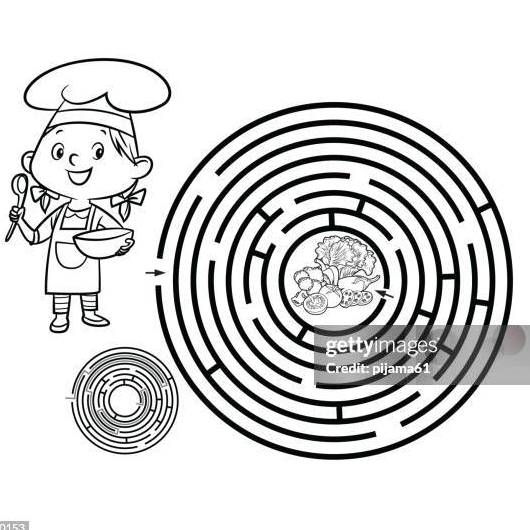
I would work from the centre outwards, similar to how backward design works
The idea of starting with the end in mind sounds obvious once you hear it. I used to be obsessed with those mazes you’d find on diner kids menus, and I always solved them end to beginning, because it was the most efficient strategy. I see the appeal of backward design, and it blows my mind that this is barely mentioned in the Bachelor of Education programme. Backward design would be fantastic, except we don’t even get our assessment class until the second semester of year 3. If I was exposed to this theory earlier, I would’ve implemented it into my practicum.
My high school Calculus teacher was one of my favourite teachers ever. She had a doctorate in math and, looking back on her class, I think she infused the idea of backward design into her lessons. She had clear exams, even practice test so we could familiarize ourselves with what kind of material would be on the exam. She never used scantron because she understood that, although math is either right or wrong, it’s easy to make mistakes, and one mistake shouldn’t cost you your grade. Finally, she only assigned homework to students who needed extra practice, understanding that for students who understood the material, it was just busy work. Her class, and her teaching style, will always stand out to me because of her clear instruction, assessment, and lack of busy work. Her class felt meaningful and learning felt fun.
Backward design ensures that the lessons are rooted in learning goals, rather than busy work or random activities. Educators must ask themselves, “What is it that I want my students to be able to do by the end?” which creates a better planned, laid out, and more holistic learning experience.
Design Thinking
Design thinking is an educational concept which is stretched over five phases:
Empathy – who is impacted and what are their needs?
Define – clarify the problem, constraints, and resources
Ideate – brainstorm possible solutions
Prototype – build or sketch possible solutions
Test – share, refine, repeat
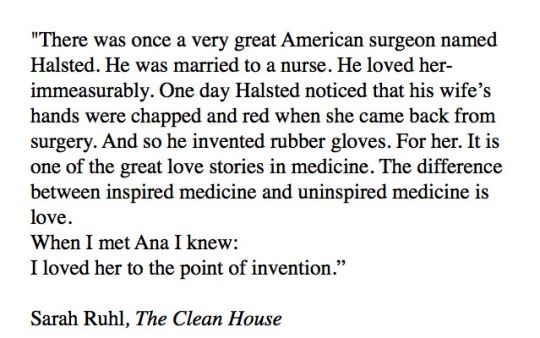
What stood out to me about design thinking is the emphasis on empathy. Problem-solving requires looking at the problem from an outside perspective, or even by stepping into someone else’s shoes. The moment I learned about this, it reminded me of an old quote:
To be loved to the point of invention, that is the goal. This story, of the creation of rubber gloves, is a romantic view of design thinking. The surgeon had to step into his wife’s shoes, see how her hands were being irritated at work, and create something to solve this problem. This process mirrors design thinking perfectly.
In my future teaching practice, I plan to invoke this framework into lessons on Indigenous land, climate change, invasive species, and more. By allowing learners to see these problems from an alternate perspective, they themself are suddenly aware of challenges presented, which makes the process of problem-solving much more meaningful.
Learning Outcomes and Taxonomies
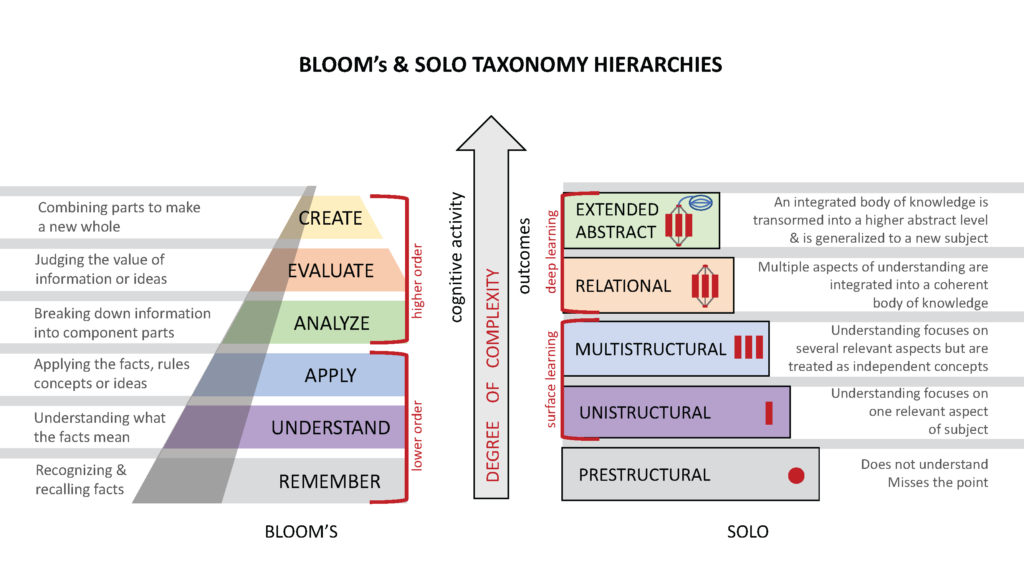
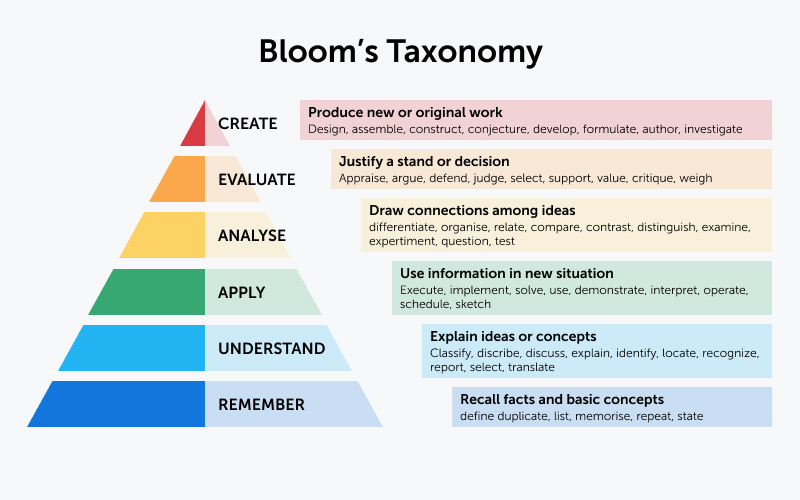
I am more than familiar with Bloom’s Taxonomy, but I have never heard of the SOLO (Structure of Observed Learning Outcomes) Taxonomy until now. Bloom’s goes into what students should be able to do at the end, using clear, measurable terms, while SOLO’s measures the depth of student learning.
Vague Verbiage
Specific Learning Outcomes
Students will know hip hop culture
Students will be able to describe the cultural significance of hip hop dance
Students will do a hip hop combo
Students will be able to demonstrate basic hop hop moves in sequence
Students will perform a dance
Students will be able to create and perform a 16-count hip hop dance
To me, I think Bloom’s is more helpful in learning design, while SOLO is more helpful in learning assessment. While I’m more familiar with Boom’s and thus partial to it, I am sure I will be getting good use out of both of these in my future career.
Better Learning Design
Surface vs Deep Learning
Surface-Level Learning
Deep Learning
Minimal effort, memorization, low-level skills
Applying, analyzing, evaluating, critiquing
Reflecting on my experiences in school, I definitely fell into surface-level learning quite a bit. I would memorize formulae and facts to pass an exam, and the moment I would see that “A,” I would completely forget everything that I learned. I was not learning the material because I was engaged, but simply because I needed to pass that test and move onto the next thing.
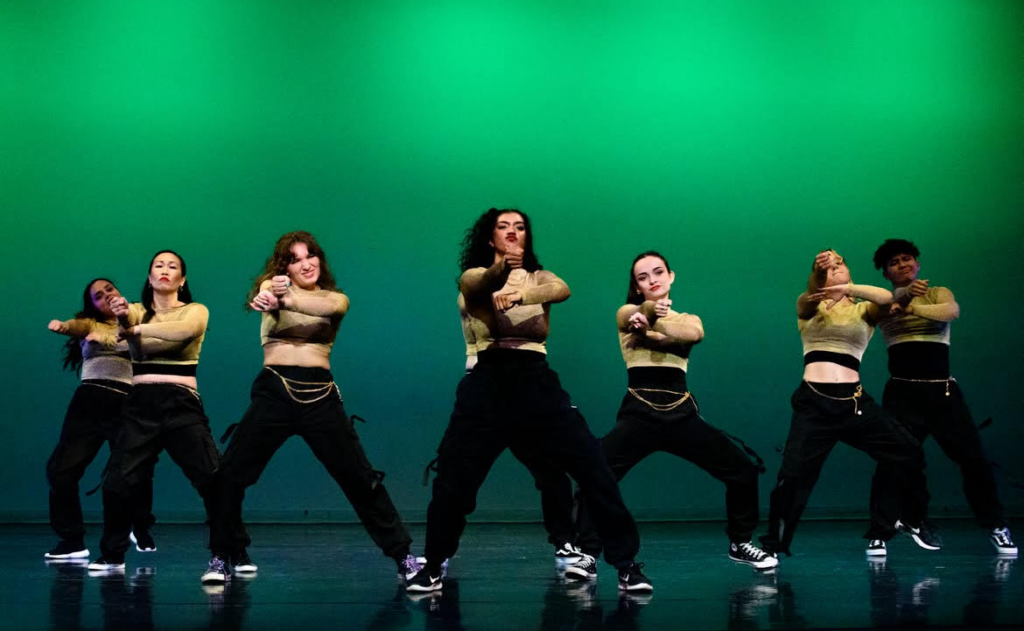
Me, (third from left), dancing for Raino Dance at the most recent June show
This contrasts completely with how I am in dance classes. I’ve been an avid dancer for six years, trained in every style you can name except ballet. In dance class, my learning is deep. I went above and beyond memorizing moves, I would practice and apply concepts of rhythm and style that still stick with me now. Between these two experiences, the design is what sets them apart. School felt objective, disconnected, and focused more on grades, while dance was hands-on, iterative, and engaging.
Inquiry and Project-Based Learning
As an education student, inquiry and project-based learning is something I’m all-too familiar with. When students get to explore something they’re interested in, using authentic questions, they feel a sense of ownership over their learning. My work in the Bachelor of Education programme has shown me this first-hand, as a large portion of our assignments are inquiry-based. These kinds of projects allow students to guide their own research, which can feel a lot more meaningful and motivating than traditional assignments.
This approach creates a more holistic learning experience and fosters a deeper connection to content, especially when tied to personal interests. Of course, it comes with many challenges too:
ensuring that inquiry projects align with the BC cirriculum
managing time for inquiry projects
providing enough structure while still allowing freedom of choice
Every good thing comes with a challenge, and I believe that the benefits of inquiry-directed learning outweigh the challenges. Project-based learning prepares students for the world outside of school, where learning comes from exploration and collaboration.
Conclusion
Module 2 helped me connect the dots between theory and practice. Backward design ensures clarity, design thinking centers empathy, Bloom’s taxonomy strengthens outcomes, and project-based learning gives students real-world ownership. Together, these ideas push learning beyond surface-level memorization into something that really sticks.
As I continue in education, I want to keep asking myself: Am I designing for deep, lasting learning?
I work at Red Robin and the Savory Steakhouse burger is hands-down the best thing on the menu. It’s got bacon, tomato, lettuce, and everything else you could ever dream of. So for this module’s community contribution, I decided to create learning objectives which focus on students learning how to make this legendary burger!
Students will be able to list the required ingredients for the Savory Steakhouse burger
Students will be able to assemble the Savory Steakhouse burger by following the recipe steps in the correct sequence
Students will be able to create their own personalized variation of the burger, while keeping the essence of the Savory Steakhouse
Hi Max! It was great to look into your blog. I wonder if you could go a little deeper in your “About Me” section by explaining what occupational therapy really is. That might help readers who aren’t as familiar with the field connect more with your perspective. While I love how your blog post is laid out so nicely, including a lot of multimedia, it would be awesome to see you infuse a bit of colour into your website to really make it pop!
I really liked how you described learning as something that comes from practice and real-life application. Your example from anatomy shows that you have strong strategies for your own learning by watching crash course videos, studying ahead of time, and taking notes. Hearing that you hand-write notes is awesome, that definitely makes the material stick in your brain! Nowadays in lecture it seems like everyone is on laptops and they’re definitely missing out on that opportunity. I’m glad to hear that these strategies helped you feel less overwhelmed and more confident.
I really relate to what you said about cognitivism. Having information organized and easy-to-follow makes such a difference when learning. I love how you connected this to your work experiences, and it’s awesome that using clear documents and hour-by-hour outlines not only helped you, but also made things go smoother for the people you were working with.
Lastly, I liked your point about self-concept in adult learning. Wanting to try things on your own first shows that independence, but also knowing when to ask for help is a super important balance. That mix of self-reliance and willingness to seek support will definitely help you in both school and your future career.
Hi Sasha! When I first looked into your blog, it was pretty basic, but it looks like you’ve really individualized it! I loved seeing the difference between you in Kindergarten and then your first day as a student teacher, that’s super cute! I know you said you wanted to infuse some colour into your site, so here is a YouTube video I found that can help you out with that!
I loved how you described learning as not just receiving information but also in the way that we interpret and connect it to the world around us. Your experience as an Early Childhood Educator really highlights how much learning is tied to trust, relationships, and early literacy. It’s easy to dismiss how much kids learn before they even get to school, just by observing and interacting with the world around them.
I understand what you said about struggling with online learning, although I’d rather be engaged in an online class than tired and disengaged because I’d dragged myself to an 8:30am. It’s not for everyone, but online learning definitely makes education more accessible. It’s great that you’ve found strategies like flashcards and Quizlet to make online learning more manageable.
Your point about confidence really stood out to me. It’s so true that students are more likely to try when they believe they can succeed, I definitely feel that way too. I like your reminder that teachers should highlight what students are already doing well, not just what they need to fix, building trust and motivation.
Lastly, I appreciate how you talked about biases in adult learning. Your math example showed how an engaging teacher can completely change how we see a subject (any chance that prof was Tom Thompson??), which is such an important concept in the career we’re going into!
Hi Sophia! I really enjoyed looking into your blog and reading your “About Me.” While I love all the multimedia you integrated into your first blog post, I wonder if you could look further into captivating titles and which title words get capitalized!
I like how you connected memory to learning and I agree that the two really go hand-in-hand. Your point about cramming really stood out to me. I’ve done that too many times, and while it works short-term, I always forget the material quickly. As an education major, I think moving assessment away from grade-based exams where students will cram to get that A toward deep-learning inquiry assignments is so important. Breaking down memory into encoding, consolidation, and retrieval makes it l easy to understand why real, deep learning takes time and practice.
I also thought it was interesting how you linked your dance teaching to these theories. Even without knowing the names of the theories at the time, you were already using them in practice, which shows how natural some of these approaches can be when teaching.
Finally, I really enjoyed your knitting example with Jenny. It showed how all the theories can overlap to make a lesson engaging and meaningful. I think if I were in her class too, I’d feel confident because I’m set up for success.
Does listening to classical music, like Mozart, make you smarter? This is a neuromyth commonly referred to as the “Mozart Effect.” The idea that listening to Mozart boosts your IQ was popularized in the ’90s in a book by Don Campbell. This neuromyth spread fast, and by 1998 the state of Georgia spent over $100 000 to distribute classical music to families with newborns. The Mozart Effect was debunked a year later.
I definitely remember hearing this neuromyth while growing up. While music can improve mood and focus, it cannot directly increase intelligence. For me, as a current learner and future teacher, this research helps me see the role of music in education. Knowing this allows me to make design choices to support learning, like using music to create an environment for concentration and creativity.
Hello and welcome to my first (of many) EDCI 335 blog posts. I am Emma, and I am currently in year 3, working on my Bachelor of Education alongside an Information Technology Certificate. The biggest experience I have had that has shaped my journey as an educator is definitely the three-week practicum I completed in May. I taught Math and Social Studies in a Grade 8 class at Rockheights Middle School and it was such an eye-opening experience. Taking EDCI classes is one thing, but to actually be in the classroom, interacting with and teaching students, taught me more than a textbook ever could.
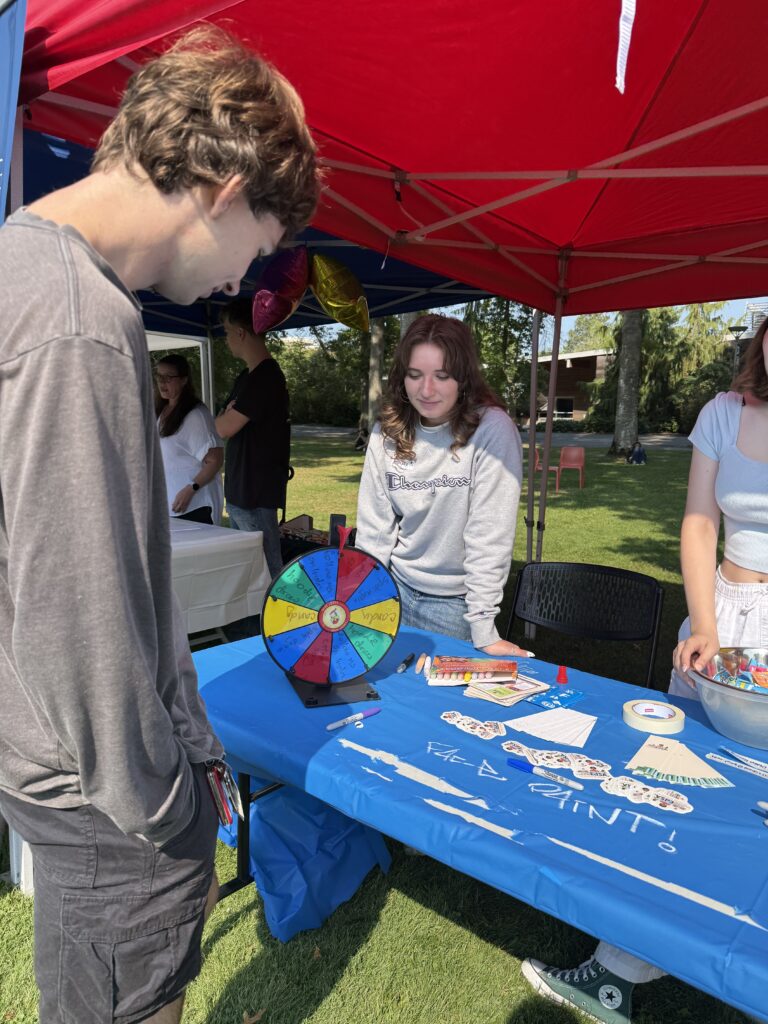
Me, running a booth for The Education Students’ Association at Thunderfest this year
To me, learning is more than just the acquisition of knowledge. I would argue that is is also the ability to identify, interpret, and organize information, connecting it to prior knowledge. I am a dancer at heart, and I think that dance can be one of the best examples of learning in action. When I learn a dance, I observe and analyze my dance teacher, try it myself, refine and practice this until it becomes muscle memory. Learning dance dips into all three non-digital learning theories: behaviourism, cognitivism, and constructivism, but I think (for me) it connects best with constructivism, as it ties new learning with my own experiences.
As for motivation in regards to the ARCS model, the biggest factor that motivates me is the A: Attention. Although Relevance, Confidence, and Satisfaction definitely play parts too, I think I am most motivated when something challenges me. Rising to a challenge excites me much more than doing something easy. This is why I’m taking seven courses this semester, and why I’ve been taking extra math courses as I’ve been at UVic: I crave a challenge. Of course, a challenge is nothing without the achievement of success. My motivation is Attention, but Satisfaction too: the satisfying outcome of completing a challenge.
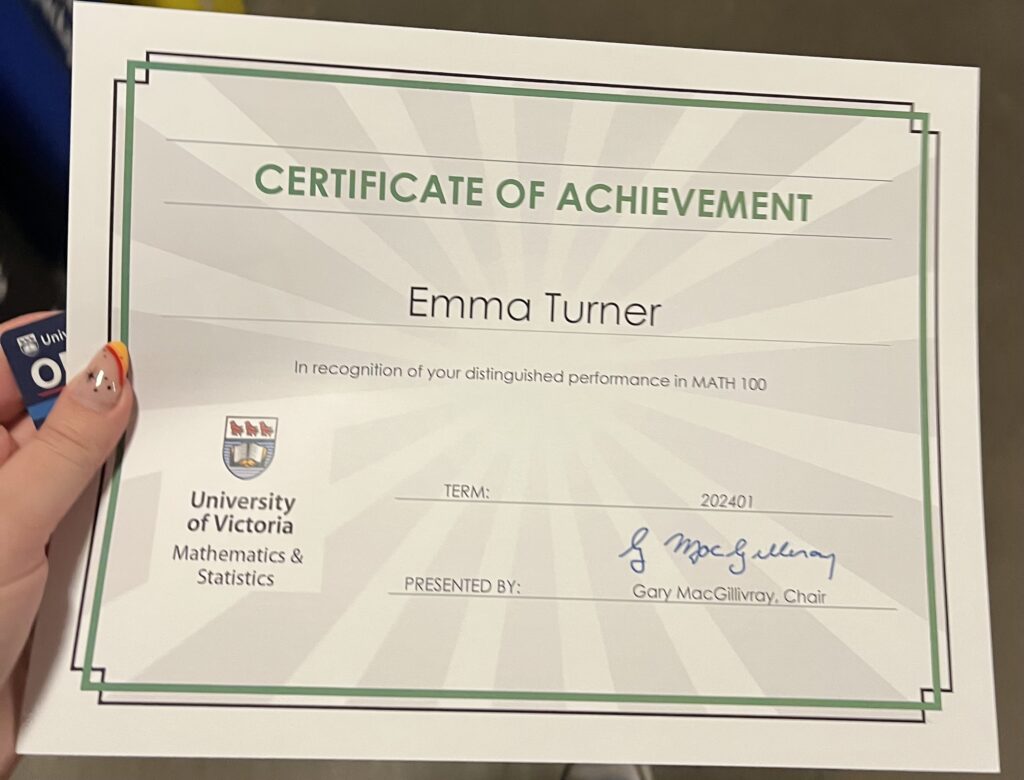
A certificate of achievement I received for Calculus I.
As an adult learner, I bring a lot of past experience into new learning. Dance has taught me persistence through challenges, how to pick up new ideas quickly, and how important critique and feedback is. Growing up in the age of technology has made me comfortable and confident in using digital tools inside the classroom.
Today I looked into a grade 7 unit on podcasting. This unit introduces students to what podcasting is, before delving into “how to speak,” or, the importance of tone, emphasis, pace, and volume. These are key elements of storytelling, especially from a digital standpoint. This unit helps students become not just great podcasters, but effective communicators too.
I think this unit would be super fun and engaging for grade seven students. Most kids at this age probably don’t listen to podcasts, so this is a great way to get them interested into this new form of media. Giving students a chance to make their own podcast taps into this interest in a hands-on way.
What works well in this unit is the structure. It begins with an informative look at what a podcast is, then explores the components of one, allows students to create their own, and ends with a student reflection. The process of learning, creating, and reflecting supports a full learning cycle, building students’ confidence with this technology. This is such a creative unit to help students build literacy skills in a fun way!