At the beginning of this course, I thought of my digital identity as simply a “portfolio of my creativity, my curated posts, [and] my lived experiences” (Turner, 2026). I had no concept of a Personal Learning Network (PLN) nor did I ever consider using social media for more than just a digital diary and a good ol’ reel scroll.
My goal for this course was to learn how to use my PLN to make myself a better educator by expanding my network. Back in July, I had only ever used social media for posting and scrolling, so it was important for me to learn how I could also use social media to support my career.
My brand-spanking-new LinkedIn profile
Growth & Reflection
One of the biggest ways I have grown so far through this course is in my understanding of using social media. More specifically, understanding of my relationship with social media and how I influence my digital identity online.
This growth in understanding came from the week on Personal Digital Identity vs Professional Digital Identity, where I was tasked with creating a Visitor and Resident Map. This assignment forced me to come face-to-face with every social platform I use and consider my intentions behind using it (is it personal? is it professional?) as well as my familiarity with the platform (am I actively creating on the platform or using it for a task?).
This made me think deeper about my social media accounts and my intention behind every post. As the course went on, my understanding of digital identities grew deeper, especially when learning about the Personal Information Protection and Electronic Documents Act (PIPEDA), Artificial Intelligence (AI), and Media Literacy Week.
Along the way, I have also grown my teaching toolbox, as I now have a variety of resources and initiatives/lessons (like the MediaSmarts video) that I can use to teach media and AI literacy to my future students.
Lastly, I have grown my PLN through peer-to-peer interactions, ranging from a group project to weekly comments on each of my blog posts. I really appreciated both giving and receiving constant feedback to ensure I was creating the best content I could. This rang especially true for the Collaborative Reflection, where I got an in-depth blog audit from Priya!
My first goal for continued learning and professional development is to continue building my PLN, or as Qualman (2012) put it: “Network before you need the network.” I am heading into my last year at UVic in September, which means I have one year left in the most networkable place to find likeminded young professionals. Going into this school year, I plan to take charge of my PLN and build my network through connecting and collaborating with peers, and staying in touch through platforms like LinkedIn!
My second goal is to make more of an impact regarding AI in education. I’ve mentioned before that I think a great first step to taking AI out of the classroom is by getting rid of AI overview in school chromebooks. I haven’t found a fix exactly, but I did find a way to bypass AI overview on Google. This is just a start, and I want to continue learning and finding out ways to make education human again.
Lastly, I want to continue learning about laws and policies regarding AI, with a focus on limiting the amount of AI we use. One step toward this goal is protesting data centres in my community and Canada as a whole. We live in one of the most beautiful areas in the world, on Indigenous land, and I will not see us dry up the world for the sake of AI. Take a cue from the Sturgeon Lake Cree Nation.
In sum, this course has allowed me to investigate my intentionality online. From the source of the information I’m sharing to the content I choose to like, comment, and post. I see now that I can never fully separate my digital identity from my “real-life” persona or professional identity. I am leaving this course with many more skills in navigating online than I began with. I am leaving as a stronger digital citizen and a better educator.
Thanks for reading everyone. Don’t hesitate to reach out 🙂
To start off, I really enjoyed how Avery kept her blog post interesting in the form of cited creative commons photographs throughout her entire post. This was a great way to break up the paragraphs and ensure that her post was more a blog and less an essay.
I chose this blog post because I found it the most interesting and retrospective. Using a V&R Map to visualize a digital footprint is such a cool concept and I loved being able to kind of pick her brain through this blog post. I think her map was easy to read/understand and I think she did a great job summarizing White and Le Cornu’s original work.
Throughout this post, Avery also connected resources with her own experience and life. This allowed me to learn more about her and understand the things that shape her learning and opinions. One stand-out to me was how she connected her experience working at the Victoria Brain Injury Society (VBIS) to expanding and diversifying her PLN. Avery says: “Working at VBIS has shown me the importance of learning directly from people with lived experience rather than relying on textbooks, Google searches, or slideshows.”
One critique I have for this post is in terms of formatting. I love grammar. I think that if your titles/headings were capitalized according to Title Case it would allow for a smoother and more neat layout. For example: How has my thinking about inclusion and PLN evolved? becomes How Has My Thinking About Inclusion and PLN Evolved? This is such a minute critique, but I think it would really perfect your blog post!
Lastly, I think that blogs are inherently multi-modal and it would really add to your post to embrace this! The photographs are great, but I think adding a YouTube video or two would be fantastic! Here are a couple options that I would add, if it were my post:
To expand further on Section 2: PLN & Digital Identity: What Digital Platforms are Students Currently Using to Develop Their Professional Network?
For readers who know nothing about VBIS:
In sum, I thought Avery’s blog post was a strong post that used her own life experience to connect to and explain course concepts. I think it was engaging and well-organized, and with a few tune-ups, would be perfect!
Attached below is our final project slideshow and the written script. Enjoy!
Avery’s Slide: What is a Personal Learning Network?
So, first, what is a personal learning network?
A Personal Learning Network is a collection of people, communities, and online resources that help us learn, share knowledge, and grow professionally. Unlike learning in the classroom, a Personal Learning Network lets us keep learning throughout our lives. Lifelong learning is becoming increasingly important as technology, workplaces, and society are constantly changing. So, people must continue to develop new knowledge and digital skills. For example, as someone hoping to work in public health, it will be important to stay educated on new research, technologies and practices throughout my career.
Effective personal learning networks are built by creating and maintaining relationships that support learning (Rajagopal et al., 2012). Strong connections lead to collaboration, and weak connections introduce us to new ideas.
How are these relationships built? People build professional relationships based on several factors. This includes things like shared interests, trust, reputation, and potential for learning. Something important to touch on while talking about Personal Learning Networks is digital identity, as the two are closely connected. Digital identity is the information, interactions, and content that represent us online, including both what we share ourselves and what others share about us (Stoller, 2016). Our digital professional identity develops through our online interactions and professional contributions (Rajab et al., 2020).
Today, Personal Learning Networks are built through participation in online communities and social media, such as commenting on others’ work and creating content. Personal Learning Networks provide much more information than what can be found alone. People are able to connect with a number of people much quicker than we would be able to do years ago (Green, 2017). For someone like Emma, she was able to connect with people throughout the world during COVID, and these relationships still continue today.
Personal Learning Networks also help us learn from diverse perspectives, give us opportunities to connect and find support, and share our own ideas and experiences with others (AlphaPlus, 2025). For Joshua, there is a sense of belonging and identity you feel when you share with others, and absorb the content others share with you.
There are many ways to build and grow a personal learning network, many of which will be explained throughout this presentation. Building a personal learning network is an ongoing process, and not everyone’s personal learning network will look the same.
To build a PLN, you have to be motivated and have a passion for learning, and you need to be able to identify your learning interests (Green, 2017). Once you know what you want to learn, you can start finding people, pages, and groups related to these interests. You also need to be motivated by social connection, as well as the opportunity to share who we are with others, according to Priya’s first blog post. For someone like Reid, motivation comes from a drive to make connections with others, so that it is not uncomfortable to ask for advice in the future. You can then explore who those people follow, to discover more people with similar interests (Eduro Learning, 2021). It is also important to seek out diverse perspectives and people that might challenge your thinking rather than only following people who share your existing viewpoints. Through social networking tools, you will be able to reach a wide variety of people and organizations.
Although, a strong PLN requires active participation, not just observation. You need to connect with these people by asking questions, as well as sharing ideas, experiences and resources. A key thing to consider when building your personal learning network is to focus on the quality of your connections, rather than the number of followers. Simply being vocal online does not mean you will gain attention, you have to have strong networks and have formed meaningful connections with those around you (Herminda, 2015).
There are also benefits of participating in different learning environments when building a PLN. Research describes the importance of combining both formal and informal learning when building a PLN (Czerkawski, 2016). Online learning environments allow formal education and informal social learning networks to work together, creating opportunities for collaboration and experimentation.
A quote I really liked from Green (2017) that explains how personal learning networks are ongoing, is to think of your personal learning network “as a garden. Sometimes planting, sometimes weeding, sometimes harvesting but always tending the garden so that it grows and is productive. Occasionally a resource may stop being useful so remove it. Other times a new, interesting resource can be added.” This describes well how a PLN requires ongoing attention, rather than being something you build once and forget.
Priya’s Slide: What are the Benefits/Negatives of Discussed Social-Media Platforms?
Starting with LinkedIn, this is probably the platform we most clearly associate with professional networking. It allows us to connect with colleagues, employers, organizations, and other professionals, while also creating a professional digital identity. Anderson explains that social networking allows people to “connect, develop rapport, share interests, create community, and collaborate with peers” (2010, p. 72). LinkedIn takes these ideas and brings them specifically into the professional world. For a PLN, this means that our learning doesn’t have to be limited to the people at our school or workplace. We can connect with professionals in different fields, follow organizations, discover opportunities, and learn from people we may never meet in person.
However, LinkedIn also raises questions about digital identity. Dyer (2016) discusses how we perform our identities differently depending on the online environment and audience. On LinkedIn, we tend to present a much more professional and polished version of ourselves than we might on Instagram or another platform.There’s also the issue of time. Building these connections will not happen immediately. Couros acknowledges that “developing a PLN requires a significant time commitment initially” (2010, p. 127). Meaning, LinkedIn can be valuable, but only if we’re willing to actually engage with and maintain that network.
Another platform that can contribute to a PLN is blogs. Blogs are a little different because they provide more space for reflection and deeper discussion. Instead of communicating through a short post, someone can explain their thinking, reflect on an experience, or share detailed professional knowledge. Blogs are actually an important part of Couros’s model of the “networked teacher.” In his course, students didn’t just write their own blogs; they were encouraged to engage in “reading, reviewing, commenting, and subscribing to blogs from outside of the course community” (Couros, 2010, p. 122). I think that’s an important distinction because a PLN isn’t just about putting information out into the world. It’s also about interacting with other people’s ideas and learning from them.
However, just because something appears in a blog doesn’t automatically make it credible. Anyone can publish one. Trilling and Fadel (2009) argue that information literacy requires us to access information effectively, evaluate it critically, and then use that information accurately. This is where we come back to media literacy. Blogs can be incredibly valuable sources of professional knowledge, but we still have to consider the author’s credibility, possible biases, how current the information is, and whether the claims can be supported elsewhere.
Moving onto Twitter, or X, this platform works very differently because it focuses much more on immediate conversations and quickly sharing information. Couros specifically identifies Twitter as a microblogging tool within PLNs (2010, p. 125). In fact, when he asked educators in his PLN questions through Twitter, he described it as his “most responsive method for surveying the connective knowledge” of his network (Couros, 2010, p. 124). Instead of searching for every answer independently, you can put a question out to your professional community and receive resources, ideas, diagrams, and perspectives from other people. This also connects back to Sophie Lui. In her EDCI 338 interview, she discusses how social media platforms such as Twitter have become important for staying connected to current conversations and information (Lui, n.d.).
But the speed that makes Twitter useful is also one of its biggest weaknesses. Information can spread extremely quickly, sometimes before anyone has actually verified whether it’s true. That’s where media literacy becomes really important. Trilling and Fadel argue that we need to be able to “evaluate information critically and competently” (2009, p. 65). So, when something appears on Twitter, we should be asking: Who posted this? Where did they get this information? Is this source trustworthy? And can I verify it somewhere else? This is especially important because, as Spracklen (2015) discusses, the openness of the internet can also create spaces for misinformation and harmful or inaccurate ideas to spread.
Facebook and Instagram serve another purpose within a PLN. These platforms are often more focused on maintaining relationships, finding communities, and connecting with people who have similar interests. Anderson explains that Facebook allows people to form virtual groups around shared interests and backgrounds (2010, p. 72), while Spracklen describes Facebook as “a great way to maintain contacts and social networks” (2015, p. 101).
For educators, I think Instagram and Facebook can be especially useful for finding teacher communities and resources. We can follow other educators, educational organizations, and accounts that share lesson ideas or classroom strategies. In that way, something we might normally think of as personal social media can also become part of our professional learning network.
However, this is also where the line between our personal and professional identities can become complicated. Spracklen (2015) discusses being conscious of what he posted online because he didn’t want to put himself “in a difficult position with students” (p. 100). I think this is especially relevant for educators because even if we consider an account personal, students, parents, colleagues, or future employers may still see it. There are also serious privacy concerns. Spracklen argues that platforms such as Facebook can “turn our personal data into a commodity to sell to others” (2015, p. 4).
Something else I found interesting was looking at how my peers use platforms that we might not immediately think of as professional learning networks. For example, in her EDCI blog, Teniola describes Discord as more of a “working space than a public profile.” But she also says that “it’s still a big part of my PLN because it’s where real problem solving and support happen” (Olukareh, 2026). I really like this example because it shows that a PLN doesn’t have to be public. A platform can still support professional learning if it’s providing a community where people ask questions, solve problems, exchange ideas, and support each other. YouTube is another example. Emma explains in her EDCI 338 blog that she uses YouTube for “researching different teaching practices/lessons” (Turner, 2026). For educators, it can provide demonstrations of teaching strategies, lesson ideas, professional discussions, and examples from other classrooms.Again, though, accessibility doesn’t equal credibility. We still have to evaluate who created the video, what their qualifications or experiences are, and whether the information they’re sharing is supported by reliable evidence.
So, when we put all of these platforms together, I think the biggest takeaway is that there isn’t one perfect platform for building a PLN. But across all of these platforms, we keep encountering the same concerns: credibility, misinformation, privacy, digital identity, audience, and the amount of time required to maintain our networks. That’s why I think media literacy and PLN development really have to go together. Having access to thousands of people and resources isn’t necessarily helpful if we don’t know how to evaluate what we’re seeing.
Ultimately, I don’t believe building a strong PLN is about being active on every social media platform. It’s about being intentional about which spaces we participate in, who we connect with, what information we trust, and how we present ourselves within those communities.
Reid’s Slide: What Features & Characteristics of Existing Media Technologies Make Them Effective for Personal Learning?
As we all know, technology is an essential aspect to all of our lives and livelihood. But oftentimes we forget to ask, why is this? What makes technology so worthwhile and effective when it comes to learning? Well, this is exactly what I am going to be breaking down, and looking into the specific characteristics that make social media and technology such an impactful learning tool. I’ll be looking into three different categories to get a better understanding of this concept, which will be learning on your own time, finding and saving information, and learning through networked connections.
Learning through networked connections is essentially a longer way of saying connectivism. Connectivism is a new theory of learning, created by George Siemens and Stephen Downes in 2005 which is built for our new digital age (Alam, 2023). The main claim of this theory is that knowledge isn’t kept in just one person’s head, but rather it’s spread throughout all kinds of different networks of people, technologies, and organizations (Alam, 2023). So what makes this kind of technology so effective? Well, it connects you to a huge network of people with different opinions, challenging your own and making you think more critically than you would have prior to networking (Duke et al., 2013). You’re exposed to all kinds of different information coming from new creative minds, so instead of learning alone, you have access to hundreds of other brains and whole new concepts. This connects with what it really means to build a PLN as you create your own web full of people and sources to learn more and deepen your understanding in a meaningful and engaging way.
Learning on your own time:
As a student growing up in such a fast paced period, I’m always running out of time whether it be for studying, working, or spending time with friends. Technology allows users to completely overlook this limitation and lets you learn at any given point. Rather than being forced to go to a library for information during their open hours, technology allows you to learn at any point in time whether it be at 4pm, or 4am. Having this asynchronous space allows you to slow down, reflect, and look back on work, not having to cram everything in a store’s open hours. And it’s not just about the convenience, but learning on your own time means you can revisit the challenging areas and tweak any areas that were challenging before (Alden Rivers et al., 2014).
Finding and saving information:
When we compare current social media to “the old days” the first topic that always gets discussed is how hard it would’ve been to find what you’re looking for than it is now. For instance you couldn’t just search up an article online and have a reference, you’d have to go into the library, search through thousands of books just to find the one you’re looking for, and then cite information from that source. I speak for myself when I say that I’m constantly taking the ease of navigation for granted and taking a step back to realize how lucky we all are to have social media is a must. Social media and new technology allow users to find any kind of information with ease, as one search normally gives you about a thousand other options you might be looking for, as well as hashtags, bookmarks, and just happening to scroll into it on your discovery feed. But finding the information is only part of the help social media provides to learning. Having all of this information in an organized, saved collection is also a huge part of learning, which researchers say is a real skill that helps you learn (Mihailidis & Cohen, 2013). When you decide to save information, you’re consistently building your own collection of knowledge that you can return to whenever and remember the information, rather than just hearing a teacher explain it once in class and never hearing it again. Overall, social media is one of the most important tools for learning, and when used to its full capacity, finding information as well as knowing where it lives afterwards is an extremely resourceful tool.
Joshua’s Slide: How Does the Discussed Technology Allow You to Enhance/Develop Your Digital Identity/Reputation?
Social Media technologies help us to build, communicate and strengthen our digital identity.
It is through the connections we make through our questions, responses and interactions with each other that models the ways we can positively support and build trust with one another.
Our digital footprints communicate who we are, what we value, and what interests us. The content we share, the conversations we participate in, and the connections we make help others understand who we are or our developing professional identity. By sharing our experiences and learning from people with different perspectives and backgrounds, we grow as lifelong learners and contribute to a more connected learning community.
As lifelong learners, we can strengthen our professional global presence by regularly sharing ideas, resources, experiences, and reflections with others. Meaningful contributions to a Professional Learning Network (PLN) help build credibility, trust, and connections. When people in the world find value in what we share, they are more likely to engage with our ideas, learn from our experiences, and collaborate with us. Over time, these contributions strengthen both our professional networks and our relationships within online communities around the globe.
Joshua’s Slide: What Are Social Considerations That Should Be Accounted For?
When participating with these technologies in our Professional Learning Network (PLN), it is important to consider how our interactions affect others and contribute to the community.
Be open-minded, respectful, and willing to connect with people who have different experiences and perspectives. Strong professional relationships are built on trust, encouragement, and mutual support.
Meaningful learning happens through discussions and active listening. As Magic Johnson said, “you have to listen and be ready to be humbled.” Being humble and listening to others helps us grow and learn from their expertise.
Actively contribute to conversations, share ideas, and support the learning of others. Inclusive participation helps create a welcoming community where everyone feels valued and respected.
What we share online can reach people far beyond our immediate network. Before posting, commenting, or sharing information, we should consider how our words may affect others. Thoughtful and responsible participation allows us to positively influence our PLN and contribute to learning on a global scale.
Emma’s Slide: How Does Technology Track and Use Your Data?
We’ve all seen something like this pop up when we access a website before. This is a cookie collection notice, which sounds yummier than it is. Google defines cookies as pieces of website data which remember information about you and your visit (Google Privacy and Terms, n.d.).
So when we agree to cookie collection, what data is being collected and how does this affect our PLN?
Data tracking, as defined by Loth (2024), is the process of a company identifying, collecting, and analyzing user data in order to “identify trends, better understand customer behaviour, [and] improve the customer experience.” By gathering information about the user, the company can adjust algorithms to better suit the user, therefore keeping them on the website for longer.
Technology tracks your data consensually through cookie collection and app policies. This data goes beyond just the things you click on, but includes your location, your phone’s movement and angle, and even the automatic scanning of private messages. This data is often shared through parent companies and other third-party platforms.
This data is used to adjust the way the website works, personalizing your experience by individualizing your advertisements and algorithm. Many companies also sell this information to data brokers and advertisement companies. Freedman (2018) reports that the data broker market is expected to profit over 500 billion dollars by 2033.
Emma’s Slide: How Does This Benefit a PLN?
While data tracking may sound scary or off-putting, it can actually be rather beneficial to our Personal Learning Networks.
Individualized algorithms allow us to view and interact with media and content that is relevant. The ball is in your court: through seeking out and interacting with useful and informative content, you can force your algorithm to continue showing you content that benefits your PLN.
Data collection can also help to build connections within your PLN through suggested creators, groups, and people online. Sites like Facebook and Instagram will use your information to promote people with similar professions, interests, or experiences, allowing you to make connections.
However, it is crucial to understand that this personalization of algorithms can also limit your PLN by pushing the same content at you, creating an echo chamber.
Emma’s Slide: What Are Privacy, Security, and Acceptable Use Policies on Social Media Platforms?
Social media platforms often ask you to consent to their privacy policies/cookie collection when using their site. While it is easy to just trust the company and select agree, it is shocking just how much information you are agreeing to give away.
Privacy policies outline how user data is collected, used, and shared. In Meta’s Privacy Policy, it outlines that it collects the content you interact with and how you interact with it, your device information (like battery level, available storage, and how strong your signal is!), and information from third-party services, like the apps you use and the ads you see.
Security policies are a set of guidelines created to protect both users on the platform and the platform itself. This involves the requirement of strong passwords, 2FA, and suspicious login alerts. Meta also employs the use of sensitive content control, and eating disorder/self-injury resources.
Acceptable Use policies define how a user may use and behave on the platform. This involves the prohibition of hate speech, threats, impersonation, and anything unlawful, including violating or encouraging others to violate any of the above terms.
Having a social media account means you agreed to the set of rules laid out by the company. Being media literate means you understand what those rules are and how they may be helping or hindering you.
Emma’s Slide: Strengths and Weaknesses
Privacy, Security, and Acceptable Use policies can bring forth both strengths and weaknesses.
These policies give users more control over their data, including what information is shared publically, the ability to manage ads, and the opportunity to view and delete user data. Tools like 2FA and login alerts make networking safer, while community guidelines help to ensure social media is a safe environment.
However, these policies are lengthy agreements that the vast majority of users do not fully read before consenting to. Social media platforms collect so much information, with users not being fully informed on what data is being collected. Community guidelines do not hold up in practice, with Lockhart (2025) reporting that online hate speech is on the rise in Canada, especially among marginalized communities. Data collection is also in the company’s favour, and they tailor an individualized algorithm designed to keep you scrolling, which can in turn trap you in an echo chamber. Lastly, your data is shared between members of parent companies. Have Instagram? Facebook has your data. Have LinkedIn? Your data is shared with Microsoft.
While social media can be a beneficial way to make connections, it is important to understand the risks associated with using social platforms.
Priya’s Slide: Provide Examples of Individuals Who Have Used a PLN to Become Leaders in a Field of Interest and Discuss Their Presence on the Platform.
Two leaders who used a PLN in their field of interest are Oprah Winfrey and Sophie Lui. Oprah’s career as a media figure, TV show host, entrepreneur and philanthropist shows how a PLN can be built through meaningful professional relationships, even before social media became such a major networking tool. Whereas, we can examine Sophie Lui, a longtime Canadian journalist and anchor with Global BC whose PLN shows a great evolution of networking in journalism and media through the years.
I think Sophie Lui is an interesting example because her career shows how networking has changed with the growth of social media. In her EDCI 338 interview, Lui talks about how, earlier in her career, networking was much more direct and intentional. She would actually cold call people and personally reach out to make connections and find opportunities. As social media became more popular, platforms like Twitter, now X, gave her another way to connect with journalists, sources, professionals, and the wider public (Lui, n.d.).
Twitter is especially relevant to journalism because so much of the profession involves staying aware of what is happening in the world and what people are talking about. For Lui, it can be a space to follow developing stories, engage with other journalists, and maintain a much larger professional network. But something important that she emphasizes is that seeing information online doesn’t automatically make it trustworthy. Journalists still have a responsibility to verify information before sharing it (Lui, n.d.).
Early in her career, Oprah actively developed relationships within the media industry and connected with people who could open doors for new opportunities. One significant example was her connection with producer Quincy Jones, which led to an opportunity to audition for The Color Purple. That opportunity helped expand her public profile and contributed to her growing career in television and media (The AI Job Search/OS, 2024). But what I find particularly interesting about Oprah’s network is that it isn’t just about knowing powerful or influential people. In a LinkedIn article, Mavilach (2025) describes successful networking as “building authentic relationships that provide mutual value over time.” I think Oprah’s career really demonstrates this idea.
Throughout her career, she has developed long-term relationships with people like Gayle King, Michelle Obama, and Deepak Chopra. But she also uses her own position to elevate people within her network (Mavilach, 2025). For example, through her television programs and Oprah’s Book Club, she has introduced authors, experts, and their ideas to audiences they may not otherwise have reached. So, in that sense, Oprah’s PLN is reciprocal. She isn’t only benefiting from her connections. She learns from and collaborates with people in her network, while also using her own platform to create opportunities for others.
Comparing Oprah and Sophie Lui, they are two different individuals with connected approaches to building a PLN. Sophie Lui demonstrates how digital platforms have expanded professional networking, while Oprah demonstrates the importance of maintaining authentic, mutually beneficial relationships.
Avery & Reid’s Slide: How Do They Use Social Media Platforms to Build Their Reputation/Presence?
There are many different ways and different social media platforms that people can use to build their reputation.
People like Mark Zuckerberg use social media, including platforms like Facebook and Instagram, to communicate with a variety of people and keep his personal learning network updated. He connects with people like other entrepreneurs, developers, and social media users. He also has to use social media platforms to stay connected within the world of technology and be aware of any advancements and trends. This presence and activity contributes to how people view him as knowledgeable and trustworthy within the technology industry.
Sara Blakley, another entrepreneur and the founder of Spanx, uses social media to share her experiences as an entrepreneur, such as her successes and challenges. By being open about her experiences, she presents herself as authentic and relatable, which can strengthen her connection with her audience.
Brian Chesky, the Co-Founder and CEO of AirBnB, is seen as having a strong presence on X and Instagram, and builds his online presence by communicating with others involved with technology, employees, and customers.
People like Oprah Winfrey use their online presence, such as Instagram and YouTube, to share recommendations, ideas, reflections, and interviews. She is seen as credible, a trusted communicator and as a prominent media figure online. Having her PLN include people like other trusted authors, journalists, and celebrities also strengthens her credibility among audiences and followers.
Lastly, Sophie Lui, the Anchor of Global News at 5 and Co-Anchor of Global News Hour at 6, uses different social media platforms for different purposes. She shares more personal parts of her life on Instagram, which makes her seem more authentic to an audience. Sophie uses X in a more professional way, communicating with her audience and sharing news and other professional information. By changing the way she uses each platform, Sophie is able to maintain both a personal connection with her audience and a professional online identity, helping to build both a personal and professional reputation.
In an era of AI and fake news after every second swipe, a person’s reputation is becoming one the most valuable and trustworthy traits out there. Because of this, learning about what makes a reliable and trusted reputation is a skill getting more valued every single day. First and foremost, I want to clarify that a reputation doesn’t just grow because someone has social media, but rather because they actively participate and communicate with others online and work hard towards making a positive appearance and back their work up with reliable information. For instance, if someone joins a discord group that is focused on a math course saying they can help tutor, but when it comes down to it they have no clue how to do the work, going forward no one will trust when they say they’re available to help because their reputation is now built on a lie. These practices on how to build a positive social media reputation apply to everyone, especially including higher followed pages and celebrities. Essentially, having a larger fan base and audience leads to viewers trusting in your authority much more than others, leading to the belief that you are in fact a trustworthy source they can rely on. Social media has created this sense of “pre-relationship” feeling, meaning that by the time someone follows your socials, buys your product, or even enjoys watching a video of yours, they immediately feel as though they can trust the information you give and that they know the “real” you (Bahn, n.d.).
Everyone: How will you know that your PLN is a success?
How will we know our personal learning networks are a success? What does success mean to us?
Joshua: Having a successful PLN means we are respectful relationship builders, humble listeners, active contributors, and thoughtful communicators who recognise that our online interactions can have a lasting impact on others.
Emma: To me, a successful PLN will look like a continuously-expanding, diverse network of relationships and connections which invite me to actively learn from unique perspectives in a holistic way. Success means that my PLN will challenge my thinking and make me a more informed educator and a more reflective and reflexive person.
Priya: I will know my PLN is a success when I have built a community of relationships with people from diverse backgrounds, each with a different perspective and a strong sense of passion, respect and care for what they do. Success is knowing that these meaningful relationships are ones I can rely on and look to for support when needed, and can make a positive impact on my life and equally their life.
Reid: Having a successful PLN in my opinion means to have created a full spider-web link with all kinds of different people, areas of subject, and overall opinions. A PLN to me, is something that can always be improved as there will always be other minds and more opinions that could benefit yourself, so I don’t believe my PLN will ever be a complete “success” but rather something I can always improve and work towards.
Avery: For me, success in a Personal Learning Network is not measured by how many people I follow or how many platforms I use. Instead, it means that I am continuously learning and discovering new perspectives, actively participating and asking questions, and applying what I have learned to my own work. As a learner and future professional, if I can look back and see that my PLN has helped me gain new knowledge and connect with others, then I know it has been a success.
When thinking about the different risks and opportunities that Artificial Intelligence (AI) introduces for digital citizenship, I fear the many risks outweigh any potential benefits. The mass integration of AI into news, social media, and search engines has absolutely dismantled any sense of trust or authenticity online. The article by MediaSmarts backs this up, reporting that two thirds of Canadians were exposed to deepfakes online just last year, with one third reporting that they themselves had used Generative AI (MediaSmarts, 2025). These numbers have doubled from the year previous.
Reading these statistics made me think about the Dead Internet Theory, or the idea that so much of the web is made up by AI bots interacting with other AI bots, that there is no room for humans online. Or, as Compute View (2025) puts it: “The internet is dead and we killed it.”
It is more important than ever to have strong media literacy skills in order to continue navigating the internet and discerning which content is AI-generated, misinformation, or enforcing extremist narratives. MediaSmarts (2025) highlights the importance of going “Wait…What?” when reading something online, rather than just taking it at face value as the truth.
Generative AI can, will, and HAS harmed people and children. Canada’s new national “AI for All” strategy aims to encourage information around AI and develop AI literacy in students, teachers, and citizens alike. While I think this is a great idea, I still believe that we need more federal policies which LIMIT AI use. While it is important that Canadians have an understanding of how to critically evaluate what they read online, it’s more important to have legal limits on using AI for deepfakes/impersonations, spreading misinformation, or, most importantly, for using AI (and all of our fresh water!) for no reason at all.
There is still no way to turn off automatic-AI search results on school chromebooks. I would say that’s a Step One change for aiding with AI literacy in schools. In my experience, in a Grade 8 practicum, the moment technology was involved, all critical thinking went out the window. The easy-A of AI is too addictive. Even on a creative writing project (a single paragraph, mind you), half of the class used AI. It is time to switch to a pen-and-paper curriculum.
One of the absolutely most despising uses of AI targets female public figures online, generating non-consensual explicit videos. This happens everyday to women, to children. Security Hero (2023) reports that deepfake pornography makes up 98% of all deepfake videos online, with 99% of the targets being women, most commonly in the entertainment industry. Laura Bates (2025) explains that this is a “digital manifestation of a larger offline truth: men target women for gendered violence and abuse.”
One example of this happened to Nina Jankowicz, an author and Top 100 Most Influential People in Artificial Intelligence (TIME, 2023). Although she is from the USA, this is a case that affects ALL women, especially those in the public eye. Jankowicz (2023) explains that this experience made her understand that “AI’s relationship with gender and women is adversarial” and that non-consensual deepfakes are used as a “strategic attack to denigrate, undermine, and embarrass women online.”
In 2023 and 2024, in Nova Scotia, a man was found taking photos of girls, using AI to take off their clothes, and share these online. He was acquitted because the AI images did not “meet the current legal definition of intimate images” (Rhodes, 2026). This definition was changed less than two months ago with the Protecting Victims Act. Many consider this change to be too little, too late, with Judge Bronwyn Duffy stating that “the law does not reflect the technology that exists today” (Hounsell, 2026).
While Canada’s AI for All strategy promises to “protect Canadians and children against the risks from AI and online harms” there are no actual ways to prevent non-consensual deepfake pornography from being created (Lopez Steven, 2026). With AI becoming more and more common, and no real protections being put in place, it is clear that women and children will continue to be harrassed through AI technology.
If I were to create a curriculum segment on media/AI literacy, I would call back to the MediaSmarts (2021) video: “What’s Real Online?” I would use the following three questions provided to teach students how to verify that something they read, see, or watch online is real:
Where did it come from?
Is it coming from a reliable source?
Has somebody debunked it already?
As a class, we would evaluate examples of both real and AI content in the form of both social media posts and websites online. I would do this sort of exercise every week, gradually increasing the difficulty and allowing students to work individually, in small groups, or as a class to determine whether or not something is AI.
Privacy Compliance
As an educator, I think that teaching data privacy comes hand-in-hand with AI literacy. With the boom of using chromebooks in the classroom, more students than ever are being used for data online. I think that Canada’s push for further AI education will help students and families understand the risks associated with using the internet, but as an educator, it is critical to do your own research on platforms students will be using in your classroom, rather than just blindly trusting them. I also wonder, do we really need so much technology in the classroom? Student data and privacy is safe on pen-and-paper. Why risk it?
While I fully intend to teach my future students about the risks of AI, I simply don’t see how using it (other than to teach AI literacy with) fits into the curriculum. It is not worth killing our planet. Don’t you love the Earth?
Against popular belief, school might actually be about more than just grades. The resource by Qualman this week showed me that a simple lesson we learned as kids may be one the most important social skills, the “Golden Rule”: treat others how you want to be treated. Just as it takes more work to frown than to smile, it takes more energy to intentionally hurt others than to be kind and positive. It is shocking how much hate exists in this world.
Digital Leader by Erik Qualman reminded me that networking online relies on intentionality as “we need to remember what we like and don’t like as followers” (Qualman, 2012, Chapter 16). Oftentimes people forget that those “big name” celebrities are humans too. It’s everybody’s first time living, and we ought to give some grace for that.
In today’s age, anyone can be an influencer. Or as Alfred Hermida (2015) puts it: “You dont need to be famous to be famous on social media.” People are naturally drawn to charisma, people who can connect with you in a moment. This quote made me think back to the TV survivalist show Dream Academy, where a group of judges were creating a new global pop star group. The judges weren’t looking for the best dancer or singer, but for star quality.
The final group: Katseye
This idea of being drawn in by charisma extends further than just pop groups, but also in digital networking. Communicating and collaborting in an authentic and confident way will allow you to reach more people and grow your PLN. Qualman gives many points for effective leadership (clear goal-setting, summarization, leaving no decisions up in the air), but his most important statement is how “you must network before you need the network” (Qualman, 2012). This rings true for me, reminding me that, as a young student in a hands-on program at UVic, I am probably in the best place to network right here, right now.
Reflecting on this course, my developing PLN, and my use of social media platforms, I have definitely grown in my thinking. Most of all, I have learned that a PLN is so much more than just LinkedIn or Instagram, but the community that shapes your education and growth. Through exploring course concepts, resources, and creating a Visitor & Resident Map (which challenged my thinking most of all), I have seen that my personal and professional identities overlap and together create my individual digital footprint.
I see the value of networking and the way that digital platforms, which I currently treat as “diaries,” can be used to collaborate and connect with diverse perspectives and create a community of lifelong learning. Nonetheless, I have become more aware of the ethical responsibilities of an online reputation, especially as a young woman going into education and working with children. Moving forward, my biggest takeaway from this course so far is the importance of media literacy and the opportunity and responsibility I have as an educator to prioritize teaching this skill in the digital age.
Your PLN and the Evolving Internet
It blows my mind how many people use generative Artificial Intelligence (AI) in their day-to-day life. I remember a few years ago, when ChatGPT was a lot newer than it is now, I was taking Calc I and was stuck on a homework question. I googled it to no avail, searched for YouTube videos of similar phrasing, but couldn’t find anything. I turned to ChatGPT and it…gave me an answer. A very wrong answer. One with impossible formulae, imagined out of thin air. It was at that moment I realized that I am smarter than an AI. It may have more knowledge and better memory, but it’s just not as intelligent as true, egotistical, first-born-child, HUMAN intelligence.
From that point on, it amazed me to see ChatGPT get so popular. Its summaries were worse than SparkNotes, its explanations were more convoluted than a YouTube video, and it had this annoying way of explaining things, like how it feels when someone “mansplains” something to you. Everyday it’s killing the environment, our home, our land, our animals, our oceans. Why is it so popular?
In the study by Estateyeh & Mindzak (2025), it did not surprise me to see that the amaze and shine of using AI wore off from the 2024 Teacher Candidates to the 2025 group. I reckon, if they were to do this study again for 2026, pre-service teachers would be even less inclined to use AI or feel like they benefit from it.
When I was in school, we had 45 minutes to plan and write an complete essay by hand. I have seen, through my own experiences teaching, students unable to write a single paragraph with a Chromebook, several class periods, and one-on-one aid. Estateyeh & Mindzak point out how AI may harm critical thinking and problem-solving skills, stating that “students may be less likely to engage in deeper cognitive processes necessary for meaningful learning” (p. 138). This turning-your-brain-to-much impact harms not only students, but teachers overrelying on AI too, as AI may “limit teacher decision-making abilities and autonomy”(Estateyeh & Mindzak, 2025, p. 137).
Basically, we are on track to end up like the humans from Wall-E:
The study mentions that AI can support equity and accessibility in the classroom through tools such as speech-to-text/text-to-speech, immediate responses to questions, and personalized adaptations. I argue that it’s 2026, we are running out of time to save our planet and reverse (or at least slow!!!!) climate change. I sincerely doubt that generative AI is the best way to be equitable and accessible. Teaching is perhaps the most human profession, and thus cannot be taken over by a robot.
My current PLN spans from online platforms like Instagram, YouTube, and WordPress to in-person peer groups, Education Students’ Association meetings/events/professional development workshops, and teacher connections from previous practica and volunteering. While my online presence is mostly used for personal use, I now see that these platforms can positively contribute to my PLN by allowing me to connect with educators from all around the world.
The article Empowering Older Adults’ Informal, Self-Directed Learning: Harnessing the Potential of Online Personal Learning Networks by Morrison & McCutheon shows that you can, in fact, teach an old dog new tricks. The authors argue that the development of online PLNs lead to lifelong learning, such as “self-directed knowledge acquisition, personal transformation, meaning-making, and contributions to facilitating healthy aging and community well-being” (Morrison & McCutheon, 2019, Introduction). This showed me a particularly valuable point of PLNs, because so many seniors end up isolated and lonely in their old age. Through the use of online PLNs, seniors were able to socialize and connect with others, create a community for similar interests, and, most important, “learn new things and learn from others” (Morrison & McCutheon, 2019, General Discussion). This showed me that PLNs are important beyond the classroom and beyond career goals.
Interacting with this resource also made me think about the strengths and weaknesses of my own PLN. The greatest strength of my PLN comes from growing up in the digital age: I inherently posess the skills to use social media and other digital platforms with ease, due to growing up learning with computers. Being able to use social media in my PLN allows for diverse perspectives and research/resources that would be unavailable without it, but also carries the risk of misinformation and the creation of my own echo chamber.
Another strength of my PLN is my wariness and disgust with generative AI, which makes a difference in ensuring that there is still an Earth to have a PLN on! This also makes sure that I am never falling into the trap of overrelying on AI or using it in a hurry without verifying facts/resources, leading to better critical thinking and better quality resources! Of course, my PLN is just beginning and has so much room to grow. Moving past this course, with the tools I’ve learned, I plan on branching out and exploring how I can use digital platforms to the fullest extent, taking after my peers and finally creating a LinkedIn account.
To echo Qualman (2012) one last time, treat others how you want to be treated. Treat the Earth well. It’s the only home we have.
When thinking about media literacy, the first thing that comes to mind is being told when I was younger to never trust Wikipedia. It’s not that Wikipedia was wrong per se, but the information (especially on smaller articles) was not necessarily verified. Teachers instilled in me to never cite it or trust its information without verifying through further research. Nowadays, I have seen students just google something for their essay and trust (dare I say copy) the AI search result. I think that media literacy is probably the most important skill of the digital age.
Media literacy is the ability to create and understand media effectively and through a critical lens (Trilling & Fadel, 2009). In a time where news spreads though social media, it is more important than ever for us to be developing and teaching media literacy skills and reducing the amount of people who trust content online without verifying if its true or not, using three questions that the MediaSmarts video provides:
Where did it come from?
Is it coming from a reliable source?
Has somebody debunked it already?
I learned a lot about media literacy when I was in school. From grade 6 to 8 we had a class called Data where we learned everything from proper (and timed) typing on a keyboard to how to properly research, cite, and understand the biases articles we read online. However, one thing it never prepared me for is the boom of AI image and video generation. The MediaSmarts video hammered this home: when trying to guess which animal picture was real and which was fake, I was completely lost.
With the explosion of social media, it’s clear that notable individuals no longer use social accounts as a digital diary. Celebrities and influencers no longer rely on television and thus tv networks, crews, and producers to get in the public eye. Now, they can simply create an Instagram account and blow up over a single reel.
The biggest point that stands out to me when I think about how celebrities are using social media is how they capitalize on a manipulable audience to sell a product. Usually, not their own product. Often, not a product they would ever use or recommend. When social media is a job, money becomes a priority, and it becomes difficult to distinguish authentic opinions from sponsored content.
Simultaneously, having an online platform reaps many benefits, allowing people to use social media for education and outreach. One stand out for me is Dr Mike Varshavski, a doctor who uses his online presence to educate and debunk health myths. My mom loves him.
A reliable PLN is cornerstone to working in the public eye. In her interview, Sophie Liu mentioned that, when first getting into the industry, she would reach out to and meet with older experts in her field to go out for coffee and pick their brain (Interview with Sophie Liu, 2026). An effective PLN would look like exposing yourself to diverse viewpoints, but promoting verifiable information supported by credible research. Oftentimes, people with low media literacy skills interpret the search for truth as a personal attack (flat earthers…anti-evolution…pro-billionaires…etc.) which leads to conflict as they associate their beliefs with their identity. This is why it is so important to have a PLN which values media literacy and puts it at the forefront of communication and learning.
The interview with Sophie Liu addressed both the risks and benefits of engaging with an audience online. She mentioned that, while social media has given her a “wider intellectual world,” it has also vastly increased the amount of anonymous hate she receives and the amount of people who experience her mess up (Interview with Sophie Liu). She mentions that, back in the age of cold calling and the Yellow Pages, viewers had to call in to complain, often calling her to complain about herself. Nowadays, hate speech is far too common online that she feels the need to distance herself from social platforms. Her point on social media making it so that a small mistake can travel the web reminded me of the classic DeeDee MegaDooDoo video, where even I have contributed to the virality of a mistake.
A quote that stood out to me from the interview with Sophie Liu is “How much am I willing to give to the public?” (In the Public Eye, 2026). This reminded me of just how accessible and personable public figures are expected to be today. Parasocial relationships are created and fed by both fans and celebrities alike. Think Taylor Swift, and the “Swifties” who may revolve their lives around her life because they feel connected to her on a personal level.
When public figures work in a position of trust, the stakes are raised again. When a workplace defines your digital identity, hobbies and events determine whether or not you’re good at your job. Even if the hobby has nothing to do with your job! For educators especially, they are expected to be modest and express a modest digital identity. In reality, teachers are in their 20s and at the bar and hitting up raves and posting content like that online attracts hate. It makes me think about the history of teaching, back less than 100 years ago when teachers were not allowed to be married or courting lest they lose their job. This same standard of incapability of teaching and having a life still exists today, especially among female teachers. For example, @hey_missteacher on instagram posts daily outfit checks, and hate comments are rampant in her comment section, praying for her to get fired over…liking fashion.
Personally, if I were to create a public account where I have an audience, I would choose to keep as much of myself out of it as possible. The less fans know, the less they can hate on, and the less information can be used against me. Think, Tame Impala:
PLN & Education
Rather than relying on professional development opportunities, educators all around the world can now create discourse through social media. From engaging in simple conversations to exchanging lessons and research, social media allows educators to broaden their PLN and stay in touch with those connections. Alec Couros outlines the strategies for developing a PLN (Couros, 2010):
Immerse yourself by using social media to grow an understanding of how it works and how it can be utilized in a variety of ways.
Strengthen PLN connections through both sharing content/resources and commenting on the content shared by others.
Get to know the people within your PLN, their backgrounds, skills, and expertise.
However, the speed of which things travel on social media can limit the effectiveness of digital platforms. I remember when there was a trend of having “minimalist classrooms,” where everything was beige. What kind of 5 year old wants to spend everyday in a completely beige room? Social media favours virality, creating an environment where best practice can be tossed out the window in favour of a fad.
I think social media definitely gets a bad reputation from an educational perspective. For example, social media propagates slang more than anything else I’ve seen. Harry Dyer mentions in his TEDTalk that social media is often looked at as something causing a downword trend in language, with slang like lowkirkuinely (lowkey+charlie kirk+genuinely) being used widely in social spheres (Dyer, 2016). While some educators look at this as “brainrot,” I see it as people online using language to its fullest extent, both creatively and critically. As society changes and progresses, “language survives and thrives and evolves” (Dyer, 2016).
Unfortunately, vulnerable people are taken advantage of on social media. Too many elders get scammed online and, with the boom of AI, this is only going to get worse. It is so important that we not only educate our students, but also our grandparents and older members of the community. They never got the chance to learn about the internet or digital identities or social media, so it is our job to share our knowledge and help out the older people around us, even if it’s as simple as helping someone figure out how to use a loyalty card (I used to be a “Scene Plus Ambassador” and that was basically my whole job).
In sum, a PLN is about participating in spaces that increase your learning. Being media-literate encourages life-long learning and ensures we won’t get stuck in an echo chamber where untrue beliefs about the world become tied to our identity as people. Media literacy is not a surplus skill, but something that needs to be taught not only in school, but in community gatherings and spaces where vulnerable people live and visit.
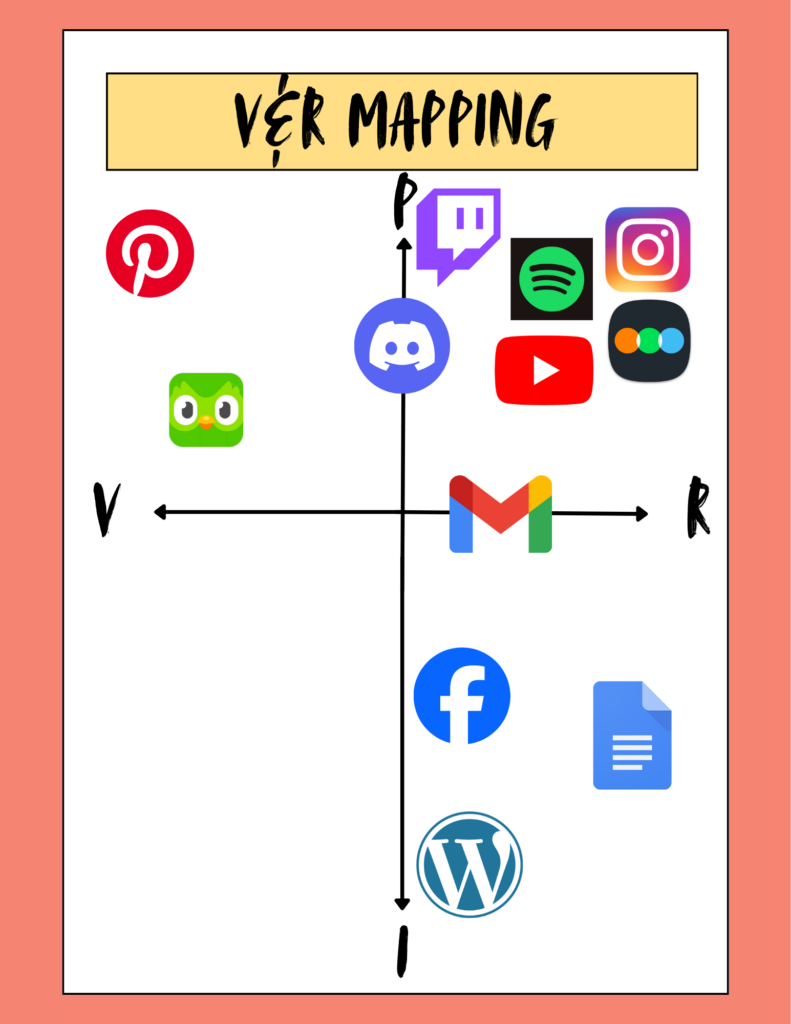
This week I explored Visitor and Resident (V&R) Mapping. V&R Mapping was first introduced by White and Le Cornu in First Monday (2011) and is a way to “make our online lives and motivations visible in a form which can be reflected upon” (White & Le Cornu, 2017, 4.2 Significance). These maps use a cartesian plane to visualize the familiarity and intention behind an individual’s use of an online platform. The x-axis goes from Visitor (using the platform to complete a task) to Resident (“living in” and creating on the platform) and the y-axis represents Personal (used for hobbies/connecting with friends) to Institutional (used for work/school) (White & Le Cornu, 2017). Creating my own V&R Map allowed me to reflect deeply on which online platforms I use, and how I use them.
Unsurprisingly, most of the digital platforms I use fall into the Personal-Resident category. What can I say, I love to critique movies, make ultra-specific curated playlists, and use YouTube to (privately) store every video I’ve ever taken. As for Personal-Visitor platforms, I really only use Pinterest to look for painted nail inspiration and Duolingo to learn Spanish. Lastly, for the Institution-Resident quarter, I put Google Docs and WordPress, as I use those for school, and (maybe surprising) Facebook, as I only use it for the Red Robin Shift Changes group!
Using a V&N Map allows me to take a step back from the platforms I call home and look at my digital identity from a different perspective. Looking at my map, I realize that I have a strong online presence, from common social medias like Instagram to more niche platforms like Letterboxd and Twitch. However, my digital identity is tied mostly to the Personal-Resident quarter, leaving room for future professional connections. While platforms like YouTube and Discord can definitely be used to cultivate a professional learning network, the truth is that I’m just not using them for that purpose. I use YouTube to upload my montages and Discord to call with my friends while we play Minecraft…
I have not intentionally created a professional learning network online. Luckily, the platforms I do use offer this opportunity for connecting with other educators/resources (especially on Instagram) and researching different teaching practices/lessons (especially on YouTube). I think that if a future employer assessed my social media presence, with me providing opportunity to view my profiles online, they would see a creative person with many passionate hobbies…but little information about my teaching philosophies, practices, or experience. However, if an employer were to just search my name up online, they would find very little, if anything at all, about me. Everything I post online is private and I never use my full name… This is important because the digitalization of our world “has modified professional roles and is changing the nature of learning and employment” for us all (White & Le Cornu, 2017, 4.2 Significance).
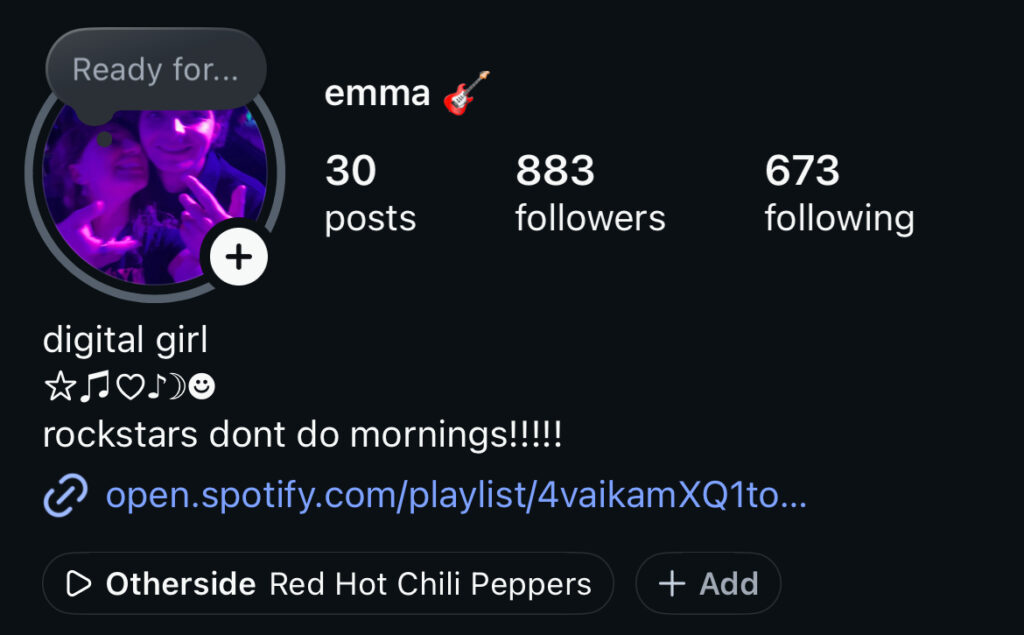
My personal Instagram account
Growing up, my parents were very on me to be conscious about my online presence, always telling me that social media is for the people you already know, so they don’t need your last name. This stuck with me for ever, from using candy-themed usernames back in middle school to my current use of “emmakailyn” on most/all platforms instead of my full name. I think having data privacy and security hammered into me from a young age made me more intentional with what information I share online and how I use content to represent myself. However, I feel like this anxiety of oversharing online may have limited potential connections outside of my friendsphere, especially more professional connections. Platforms where professional connections are at the forefront (like LinkedIn) allow individuals to create a digital reputation, shaped by their posts, on a site used by many employers. Maybe it is time to finally sign up for a LinkedIn account…
While these online platforms allow for professionals to collaborate with one another and share and consume resources/research, Regan and Jesse (2019) warn that the online algorithms can lead to echo chambers where students are “subtly tracked into learning paths that machine learning algorithms, rather than teachers or parents, decide are best for them” (Regen & Jesse, 2019, p. 178). This reminds me, as a future educator, that building a Personal Learning Network (PLN) online is more than just connecting with and learning from the people we surround ourselves with, but also about being critical when consuming content online and, as an educator, ensuring I provide students with the right tools to be a critical thinker in a digital landscape.
PLN – Inclusion and Community Engagement
I think that the question of “how diverse is your PLN?” is a hard one to answer. I think my PLN is becoming more diverse each day, as I learn from new people, new experiences, old friends with new experiences, old friends recalling old experiences… and so on and so forth. My PLN is expanding and diversifying every day, and yet, in the grand scheme of things, it is probably too homogenous, too similar.
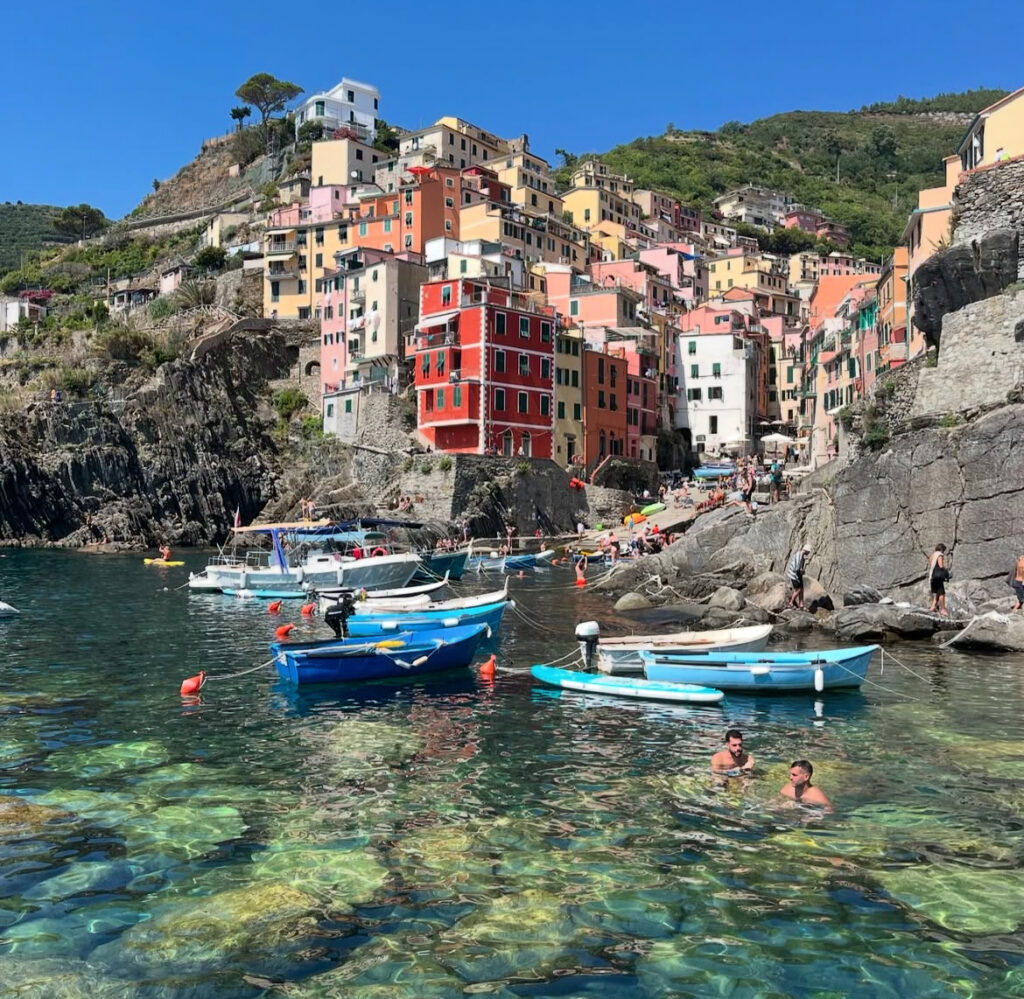
Cinque Terre, Italy. Photo credit: Emma Turner
Something that has expanding my personal learning network more than ever is my privilege and love of travelling. Once I graduated high school, I began working full time as a cashier to bank my funds and travel the world. It was through this experience that I really felt I grew up, into not only an adult but the person I am today. Travelling showed me just how big the world really is, and allowed me to experience new languages and cultures I would never have had the opportunity to connect with if I had stayed in Canada. Throughout my travels, I have been able to chat with and learn from people all over the world.
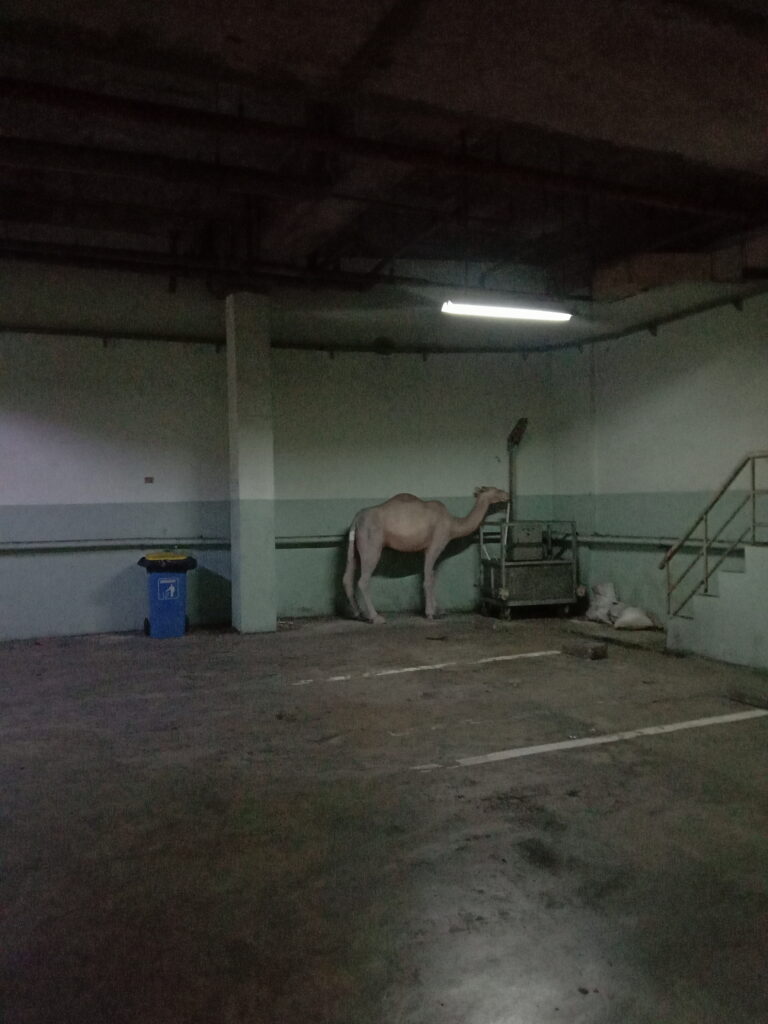
Of course, my PLN is diversified as well due to my online friends, as they share with me perspectives and experiences that are so completely unique to their lives. For instance, a couple of years ago my friend Nae, who lives in Indonesia, texted me because there was a camel in the parkade she was in. I thought she was joking. Lo and behold: the camel in the parkade.
These kind of experiences taught me to approach the unknown with curiosity and the want to learn more, rather than assumptions based on my lived experiences. So my PLN exposes me to diverse voices, but I think there are so many more voices missing. Sure I have friends from the other side of the world, but we still listen to the exact same music, speak English, exist in the same community of queer women…we are more similar than we are different. All the ocean does is separate us physically. As Dr Shelley Moore reminds me, “inclusion is finding the balance between belonging in communities of identity and communities of diversity” (Moore, 2025, “Inclusion is Not Assimilation”).
So I think my answer to how diverse my PLN is, is going to be “not very much.” I am drawn to my current connections through comfort in identity and commonalities, but am lacking in the diversity department, and therefore lacking in the opportunity to further learn from others.
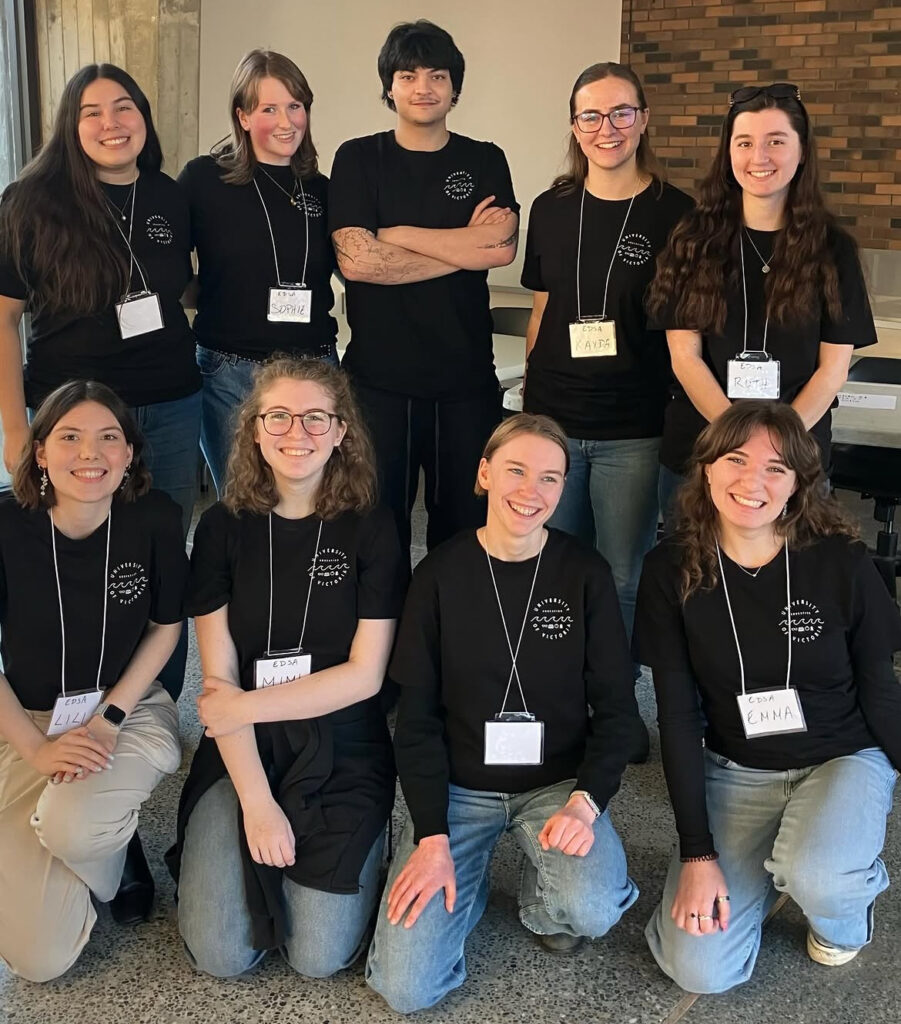
2026-2027 EdSA Executive team (I’m the bottom right)! Photo credit: @UVicEdSA on Instagram
A learning outcome of my PLN is to learn from others around me to become a better educator. I want to be inclusive, kind, passionate, and a good teacher. However, as Dr Shelley Moore reminds me, the want to be inclusive is not enough, as she notes that she has “never stepped into a school whose mission statement values segregation and exclusion, [but has] seen, in many schools, students experiencing all of exclusion, segregation, integration, and inclusion depending on the day, time, teacher, support staff, subject area, and grade” (Moore, 2016, p. 17). This reminds me that inclusion is an active task, where “100% of the time we are striving to be more inclusive” (Moore, 2016, p. 33).
One of the greatest way I expand my PLN to meet this goal is through my work at UVic’s Education Student Association (EdSA) where I have been an executive member for three years. Working on EdSA has allowed me to connect with faculty, students, and teachers/psychologists in the local community to further build my pedagogical knowledge. As Dr Shelley Moore notes that her understanding of inclusion is continously expanding, I remind myself that diversifying my PLN is a lifelong task that will allow me to create inclusive learning environments for my future students (Moore, 2025, “Inclusion is Not Assimilation”).
Evolution of Thinking; re: Inclusion and PLN
After reading, watching, and reflecting on the material this week, I have come to see my PLN as less of a collection of people I know, and more of the values and philosophies I reflect, showing what biases may impact my future teaching. The use of social media and digital platforms have transformed the way educators all across the world can share resources, lesson plans, and learn from people they would have never had the opportunity to connect with otherwise. Whether this happens through Instagram reels, LinkedIn, or Discord, it allows for collaboration, and therefore further opportunities to challenge one’s previous biases, supporting inclusion and equity in the classroom.
Simultaneously, social media challenges communications due to the capitalistic greed of social algorithms, designed to keep you engaged and doom-scrolling forever. Developers want to keep you on their app, and they’ll do whatever it takes: even if that means changing your algorithm to encompass only extreme takes and controversial content. Marginalized voices and smaller creators are tossed to the side in favour of viral videos.
From an objective standpoint, social media is designed to be inclusive: it connects people from all walks of life, all around the world, allowing everyone to use the internet how they prefer. However, with anonymity comes negativity, with users often turning to harrassment like racism, sexism, and homophobia on any post that’s not by a cis white man. So, subjectively, I think social media is rather exclusive, favouring the oppressors, and lacking the necessary tools to ensure users cannot be terrible people just because they’re behind a screen. While employers look for and expect their employees to be respectful online, the truth is that hateful people will be hateful, and too many users have fake, no-profile picture accounts to disconnect themselves from their real life online.
Before this, I have never really considered whether or not the people I surround myself by and learn from amplifies the view of others. I think of myself more like a sponge, absorbing information from every facet around me, but never quite creating content to amplify marginalized voices. For example, I am passionately anti-genocide and occupation (as you’d assume everyone would be…) and thus am very pro-Palestine, from spending time researching Palestinian culture and circumstances to attending Palestine protests in both Victoria and Quebec. However, I have never used online platforms to share my research, protest information, or anything pro-Palestine. I write this off as my use of social media being a collage of my life, but I think, moving forward, I could be a lot more intentional with amplifying voices.
In sum, a diverse and inclusive PLN ensures that we are continously learning, instead of hitting a stalemate echo chamber where everyone around us shares the same thought process. As a future educator, connecting with others within the teaching community allows me to learn from a variety of teaching styles, philosophies, and cultures, creating a more inclusive and equitable environment for my students, and making me a better teacher!
Growing up in the digital generation, most of my life has been memorialized on social media. My mom (like most women in their mid 40s) is an avid Facebook user who has been posting on the platform since 2007. As a result, my life is documented via pictures and stories on her profile. The apple doesn’t fall far from the tree either, as I love using Instagram as a digital diary, Letterboxd to critique films, and YouTube to privately post an abundance of videos and montages to look back on. It’s rare to find someone completely disconnected from social media. As Karl Spracklen notes in “Identity-Making and Social Media,” the internet has become a space where people form community and find a sense of belonging. Social media, to me, is a time capsule, scrapbook, and diary all in one.
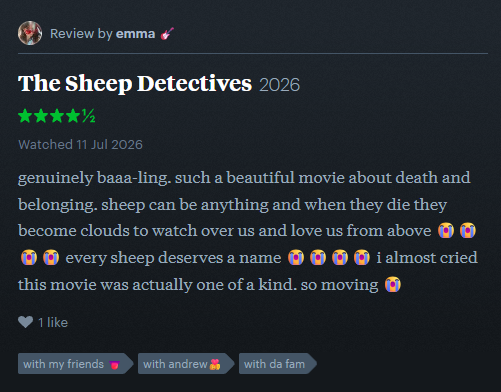
My most recent Letterboxd review…
On the other hand, I think social media fuels self-obsession, or, at the very least, self-facination. I know I am guilty of this. I will perfectly curate an Instagram story, fitted with the perfect 10-second sample of my newest song obsession, and once I post it, I will rewatch that story a handful of times. It’s not like I’m checking who watched it or who liked it; it’s not like I forgot what I posted. Instead, it’s my own self-facination, my digital ego. In creating that story, I became my target audience. The chosen song is my favourite song, the picture is my favourite picture. In sum, I have created the perfect story, that I enjoy watching… so I watch it… again… and again… and again… And it seems like many people do the same, cue the following Instagram reel:
What I’m trying to say with all of this is that I tend to think of my digital identity as a portfolio of my creativity, my curated posts, my lived experiences. What I fail to recognize is that this portfolio is not fully authentic, but curated for an audience, even if I think that audience is me. My presence online has been in the works since 2007 and is a collection of the playlists I’ve made, the reels I’ve liked, the movie reviews I’ve commented on, and more. It extends past myself as an individual, and into how my engagement on the internet intersects with others. Interesting to note, Jawed, Mahboob, and Yasmeen found in “Dear Internet! Who Am I?” that this interaction actually reduces interpersonal communication skills, rather than providing a space to develop and strengthen them.
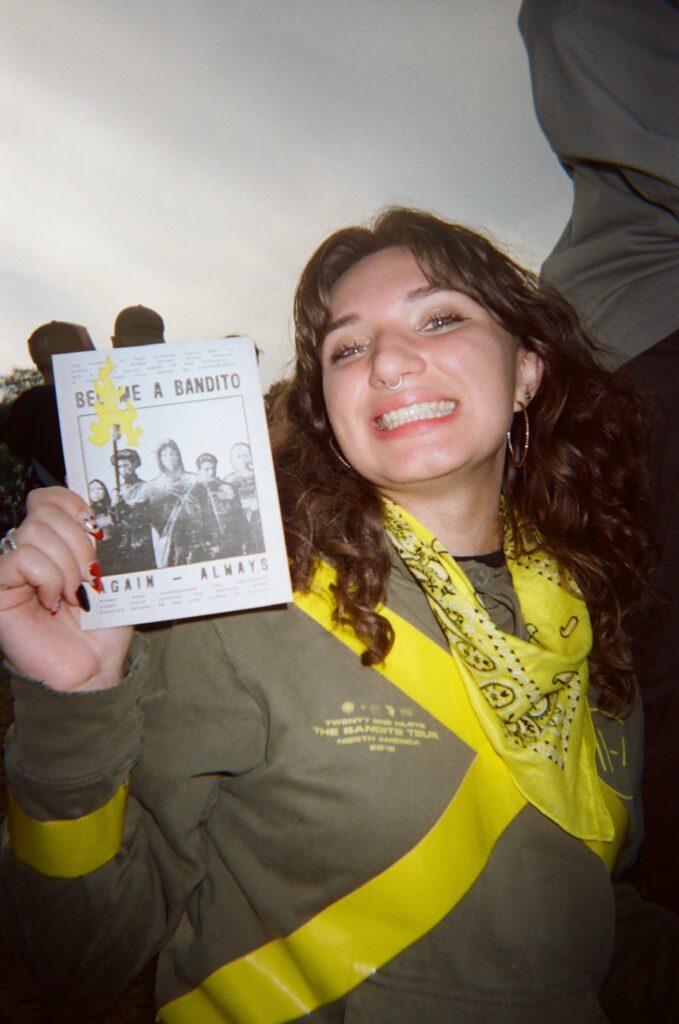
It is incredible how you can form connections with people on the other side of the world through social media. When the world shut down in 2021, I was cooped up inside everyday and started talking to a group of girls from Calgary, India, Indonesia, and California on Discord because we all had the same favourite band. Now, five years later, I still talk to those same girls every day. (And I’ve even met one of them!)
Photo credit: Emma Turner (me, in Toronto, seeing that very band last year!)
You can now build connections anywhere, at any time, and with anyone around the globe. It’s powerful and scary and beautiful all at the same time. Jane Hart defines this communicatory network as the “trusted connections with whom an individual interacts (and learns from) on a regular basis” (as quoted in “What are Personal Learning Networks”). Danah Boyd reiterates this idea, claiming that we are solely “the product of the people we know.” Engagement on the web may seem insignificant or minute in the grand scheme of things, but it’s clear that every like/comment/post impacts both yourself and the people within your network.
I enjoy a good Reel scroll in my free time and often come across professional social media accounts. Gone are the days of cold calling, and now instead, real estate agents make edits of houses on the market. Social media gives these professionals the opportunity to broaden their skills through discussions with experts and access to online courses, workshops, and conferences, turning social media into a learning environment. But can those same professionals fully disconnect themselves from their personal identity online? I don’t think, in this age, you can fully, 100% separate your professional presence with your personal one. A professional social media can lead employers to hire you, based off of the content you post, but this can also lead to personal social media ending careers, re: cancel culture.
While the idea of “cancelling” someone can definitely seem just, I’ve seen it used to define who is allowed to make mistakes and who deserves to lose their career. I’ve found that women are far more criticized than men in the public eye, and public criticism is warped by power influences in society: intersectionality plays a crude role in who is allowed to combine the personal and professional. Take, for instance, the idea that Donald Trump can post any AI-generated racist video he wants, Chris Brown is still selling out arenas after abusing women, but Chappell Roan was “cancelled” for having security detail keep children away from her at a hotel.
So while social media provides a number of opportunities to connect with brands, find customers, share ideas, and connect with other like-minded people, it can also sweep the rug out from under your feet. In the spotlight of online, where everyone can be anonymous, it is the users vs you. Misunderstandings and previous bias from societal power influences can make or break a public image.
Everything you post, interact with, and consume adds to your digital identity. There is no longer a separation between the professional and the personal, and there is no deleting something once it’s out on the internet. As Danah Boyd states in the 2012 “Networked Privacy:” “the future is only going to be more networked [and] more interwoven.” The future is now.
So it’s important to reiterate Jawed, Mahboob, and Yasmeen (2019)’s point on how it is critical to incorporate the concept of digital identity and internet safety into the curriculum. Students must be armed with knowledge on what it truly means to put your life online, and how your digital identity can affect those around you. Your digital identity is the communities you engage with and the ideas you reinforce, encompassing your entire life. The internet is no longer separate from “real life,” and should be treated as a part of our society and a part of our education system.
Hello! I’m Emma, a fourth-year student in the Bachelor of Education programme at UVic, concurrently working on my Information Technology Certificate, although I do plan on getting my Master of Education as well. I’m a 21 year-old rockstar, born, raised, and currently living in beautiful Victoria BC. Objectively, I speak only English, but in my heart I speak many more languages.
Photo credit: Emma Turner
I seldom have free time, between school, working, dancing, and spending time with friends/family. I am a proud executive member of the Education Students’ Association, where I coordinate events and opportunities for all Education students at UVic! I love to travel, and most recently spent time in England and France, then backpacked Italy and Quebec. I also love camping, gaming, reading, and critiquing movies, and I personally consider “goofing around” and “having a good time” two very important hobbies in my life.
My dream is to own lakefront property, where I drive a boat to school to teach everyday. I would be exactly like the teacher from School of Rock and my 4/5 students would be the new-and-improved Pink Floyd. Lastly, I’m a math fiend and will do anything I can to get my hands on some math. I most recently took two extra courses outside of our program, Logic and Foundations and Calculus I, just to expand my horizons a little. It was awesome and I can’t wait to take more.
For my EDCI 335 Interactive Learning Resource, I created a Social Studies 8 unit that delves into life in the Late Middle Ages of Europe, hosted on Google Classroom!