Category: Uncategorised

Balancing PLN, Media Literacy, & Public Discourse

When thinking about media literacy, the first thing that comes to mind is being told when I was younger to never trust Wikipedia. It’s not that Wikipedia was wrong per se, but the information (especially on smaller articles) was not necessarily verified. Teachers instilled in me to never cite it or trust its information without verifying through further research. Nowadays, I have seen students just google something for their essay and trust (dare I say copy) the AI search result. I think that media literacy is probably the most important skill of the digital age.

Media literacy is the ability to create and understand media effectively and through a critical lens (Trilling & Fadel, 2009). In a time where news spreads though social media, it is more important than ever for us to be developing and teaching media literacy skills and reducing the amount of people who trust content online without verifying if its true or not, using three questions that the MediaSmarts video provides:

Where did it come from?

Is it coming from a reliable source?

Has somebody debunked it already?

I learned a lot about media literacy when I was in school. From grade 6 to 8 we had a class called Data where we learned everything from proper (and timed) typing on a keyboard to how to properly research, cite, and understand the biases articles we read online. However, one thing it never prepared me for is the boom of AI image and video generation. The MediaSmarts video hammered this home: when trying to guess which animal picture was real and which was fake, I was completely lost.

With the explosion of social media, it’s clear that notable individuals no longer use social accounts as a digital diary. Celebrities and influencers no longer rely on television and thus tv networks, crews, and producers to get in the public eye. Now, they can simply create an Instagram account and blow up over a single reel.

The biggest point that stands out to me when I think about how celebrities are using social media is how they capitalize on a manipulable audience to sell a product. Usually, not their own product. Often, not a product they would ever use or recommend. When social media is a job, money becomes a priority, and it becomes difficult to distinguish authentic opinions from sponsored content.

Simultaneously, having an online platform reaps many benefits, allowing people to use social media for education and outreach. One stand out for me is Dr Mike Varshavski, a doctor who uses his online presence to educate and debunk health myths. My mom loves him.

A reliable PLN is cornerstone to working in the public eye. In her interview, Sophie Liu mentioned that, when first getting into the industry, she would reach out to and meet with older experts in her field to go out for coffee and pick their brain (Interview with Sophie Liu, 2026). An effective PLN would look like exposing yourself to diverse viewpoints, but promoting verifiable information supported by credible research. Oftentimes, people with low media literacy skills interpret the search for truth as a personal attack (flat earthers…anti-evolution…pro-billionaires…etc.) which leads to conflict as they associate their beliefs with their identity. This is why it is so important to have a PLN which values media literacy and puts it at the forefront of communication and learning.

The interview with Sophie Liu addressed both the risks and benefits of engaging with an audience online. She mentioned that, while social media has given her a “wider intellectual world,” it has also vastly increased the amount of anonymous hate she receives and the amount of people who experience her mess up (Interview with Sophie Liu). She mentions that, back in the age of cold calling and the Yellow Pages, viewers had to call in to complain, often calling her to complain about herself. Nowadays, hate speech is far too common online that she feels the need to distance herself from social platforms. Her point on social media making it so that a small mistake can travel the web reminded me of the classic DeeDee MegaDooDoo video, where even I have contributed to the virality of a mistake.

A quote that stood out to me from the interview with Sophie Liu is “How much am I willing to give to the public?” (In the Public Eye, 2026). This reminded me of just how accessible and personable public figures are expected to be today. Parasocial relationships are created and fed by both fans and celebrities alike. Think Taylor Swift, and the “Swifties” who may revolve their lives around her life because they feel connected to her on a personal level.

When public figures work in a position of trust, the stakes are raised again. When a workplace defines your digital identity, hobbies and events determine whether or not you’re good at your job. Even if the hobby has nothing to do with your job! For educators especially, they are expected to be modest and express a modest digital identity. In reality, teachers are in their 20s and at the bar and hitting up raves and posting content like that online attracts hate. It makes me think about the history of teaching, back less than 100 years ago when teachers were not allowed to be married or courting lest they lose their job. This same standard of incapability of teaching and having a life still exists today, especially among female teachers. For example, @hey_missteacher on instagram posts daily outfit checks, and hate comments are rampant in her comment section, praying for her to get fired over…liking fashion.

https://www.instagram.com/reel/DSQ5U9TgVB9/?utm_source=ig_web_copy_link&igsh=MzRlODBiNWFlZA==

Personally, if I were to create a public account where I have an audience, I would choose to keep as much of myself out of it as possible. The less fans know, the less they can hate on, and the less information can be used against me. Think, Tame Impala:

PLN & Education

Rather than relying on professional development opportunities, educators all around the world can now create discourse through social media. From engaging in simple conversations to exchanging lessons and research, social media allows educators to broaden their PLN and stay in touch with those connections. Alec Couros outlines the strategies for developing a PLN (Couros, 2010):

  1. Immerse yourself by using social media to grow an understanding of how it works and how it can be utilized in a variety of ways.
  2. Strengthen PLN connections through both sharing content/resources and commenting on the content shared by others.
  3. Get to know the people within your PLN, their backgrounds, skills, and expertise.

However, the speed of which things travel on social media can limit the effectiveness of digital platforms. I remember when there was a trend of having “minimalist classrooms,” where everything was beige. What kind of 5 year old wants to spend everyday in a completely beige room? Social media favours virality, creating an environment where best practice can be tossed out the window in favour of a fad.

I think social media definitely gets a bad reputation from an educational perspective. For example, social media propagates slang more than anything else I’ve seen. Harry Dyer mentions in his TEDTalk that social media is often looked at as something causing a downword trend in language, with slang like lowkirkuinely (lowkey+charlie kirk+genuinely) being used widely in social spheres (Dyer, 2016). While some educators look at this as “brainrot,” I see it as people online using language to its fullest extent, both creatively and critically. As society changes and progresses, “language survives and thrives and evolves” (Dyer, 2016).

Unfortunately, vulnerable people are taken advantage of on social media. Too many elders get scammed online and, with the boom of AI, this is only going to get worse. It is so important that we not only educate our students, but also our grandparents and older members of the community. They never got the chance to learn about the internet or digital identities or social media, so it is our job to share our knowledge and help out the older people around us, even if it’s as simple as helping someone figure out how to use a loyalty card (I used to be a “Scene Plus Ambassador” and that was basically my whole job).

In sum, a PLN is about participating in spaces that increase your learning. Being media-literate encourages life-long learning and ensures we won’t get stuck in an echo chamber where untrue beliefs about the world become tied to our identity as people. Media literacy is not a surplus skill, but something that needs to be taught not only in school, but in community gatherings and spaces where vulnerable people live and visit.
Personal Digital Identity vs Professional Digital Identity

V&R Mapping

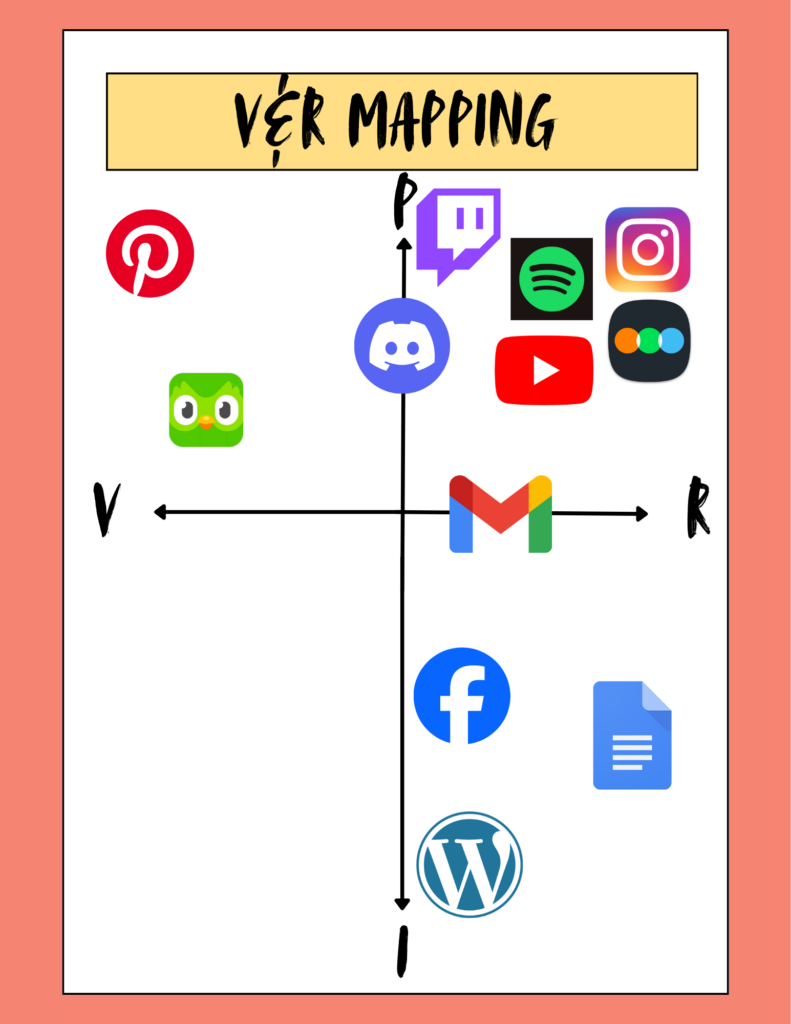
This week I explored Visitor and Resident (V&R) Mappin. V&R Mapping was first introduced by White and Le Cornu in First Monday (2011) and is a way to “make our online lives and motivations visible in a form which can be reflected upon” (White & Le Cornu, 2017, 4.2 Significance). These maps use a cartesian plane to visualize the familiarity and intention behind an individual’s use of an online platform. The x-axis goes from Visitor (using the platform to complete a task) to Resident (“living in” and creating on the platform) and the y-axis represents Personal (used for hobbies/connecting with friends) to Institutional (used for work/school) (White & Le Cornu, 2017). Creating my own V&R Map allowed me to reflect deeply on which online platforms I use, and how I use them.

Unsurprisingly, most of the digital platforms I use fall into the Personal-Resident category. What can I say, I love to critique movies, make ultra-specific curated playlists, and use YouTube to (privately) store every video I’ve ever taken. As for Personal-Visitor platforms, I really only use Pinterest to look for painted nail inspiration and Duolingo to learn Spanish. Lastly, for the Institution-Resident quarter, I put Google Docs and WordPress, as I use those for school, and (maybe surprising) Facebook, as I only use it for the Red Robin Shift Changes group!

Using a V&N Map allows me to take a step back from the platforms I call home and look at my digital identity from a different perspective. Looking at my map, I realize that I have a strong online presence, from common social medias like Instagram to more niche platforms like Letterboxd and Twitch. However, my digital identity is tied mostly to the Personal-Resident quarter, leaving room for future professional connections. While platforms like YouTube and Discord can definitely be used to cultivate a professional learning network, the truth is that I’m just not using them for that purpose. I use YouTube to upload my montages and Discord to call with my friends while we play Minecraft…

I have not intentionally created a professional learning network online. Luckily, the platforms I do use offer this opportunity for connecting with other educators/resources (especially on Instagram) and researching different teaching practices/lessons (especially on YouTube). I think that if a future employer assessed my social media presence, with me providing opportunity to view my profiles online, they would see a creative person with many passionate hobbies…but little information about my teaching philosophies, practices, or experience. However, if an employer were to just search my name up online, they would find very little, if anything at all, about me. Everything I post online is private and I never use my full name… This is important because the digitalization of our world “has modified professional roles and is changing the nature of learning and employment” for us all (White & Le Cornu, 2017, 4.2 Significance).

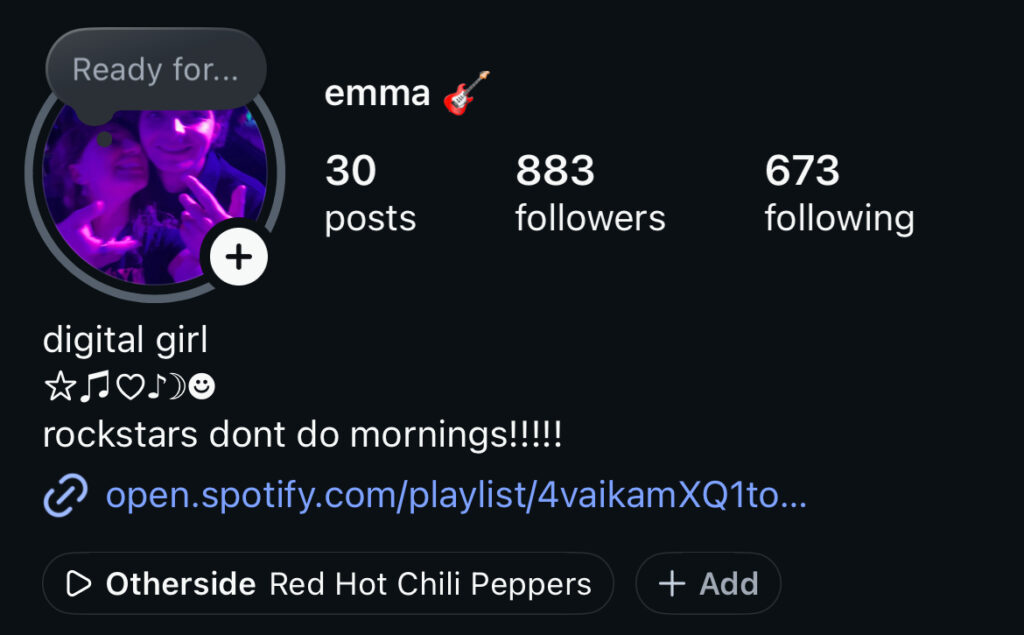
My personal Instagram account

Growing up, my parents were very on me to be conscious about my online presence, always telling me that social media is for the people you already know, so they don’t need your last name. This stuck with me for ever, from using candy-themed usernames back in middle school to my current use of “emmakailyn” on most/all platforms instead of my full name. I think having data privacy and security hammered into me from a young age made me more intentional with what information I share online and how I use content to represent myself. However, I feel like this anxiety of oversharing online may have limited potential connections outside of my friendsphere, especially more professional connections. Platforms where professional connections are at the forefront (like LinkedIn) allow individuals to create a digital reputation, shaped by their posts, on a site used by many employers. Maybe it is time to finally sign up for a LinkedIn account…

While these online platforms allow for professionals to collaborate with one another and share and consume resources/research, Regan and Jesse (2019) warn that the online algorithms can lead to echo chambers where students are “subtly tracked into learning paths that machine learning algorithms, rather than teachers or parents, decide are best for them” (Regen & Jesse, 2019, p. 178). This reminds me, as a future educator, that building a Personal Learning Network (PLN) online is more than just connecting with and learning from the people we surround ourselves with, but also about being critical when consuming content online and, as an educator, ensuring I provide students with the right tools to be a critical thinker in a digital landscape.

PLN – Inclusion and Community Engagement

I think that the question of “how diverse is your PLN?” is a hard one to answer. I think my PLN is becoming more diverse each day, as I learn from new people, new experiences, old friends with new experiences, old friends recalling old experiences… and so on and so forth. My PLN is expanding and diversifying every day, and yet, in the grand scheme of things, it is probably too homogenous, too similar.

Cinque Terre, Italy. Photo credit: Emma Turner

Something that has expanding my personal learning network more than ever is my privilege and love of travelling. Once I graduated high school, I began working full time as a cashier to bank my funds and travel the world. It was through this experience that I really felt I grew up, into not only an adult but the person I am today. Travelling showed me just how big the world really is, and allowed me to experience new languages and cultures I would never have had the opportunity to connect with if I had stayed in Canada. Throughout my travels, I have been able to chat with and learn from people all over the world.

Of course, my PLN is diversified as well due to my online friends, as they share with me perspectives and experiences that are so completely unique to their lives. For instance, a couple of years ago my friend Nae, who lives in Indonesia, texted me because there was a camel in the parkade she was in. I thought she was joking. Lo and behold: the camel in the parkade.

These kind of experiences taught me to approach the unknown with curiosity and the want to learn more, rather than assumptions based on my lived experiences. So my PLN exposes me to diverse voices, but I think there are so many more voices missing. Sure I have friends from the other side of the world, but we still listen to the exact same music, speak English, exist in the same community of queer women…we are more similar than we are different. All the ocean does is separate us physically. As Dr Shelley Moore reminds me, “inclusion is finding the balance between belonging in communities of identity and communities of diversity” (Moore, 2025, “Inclusion is Not Assimilation”).

So I think my answer to how diverse my PLN is, is going to be “not very much.” I am drawn to my current connections through comfort in identity and commonalities, but am lacking in the diversity department, and therefore lacking in the opportunity to further learn from others.

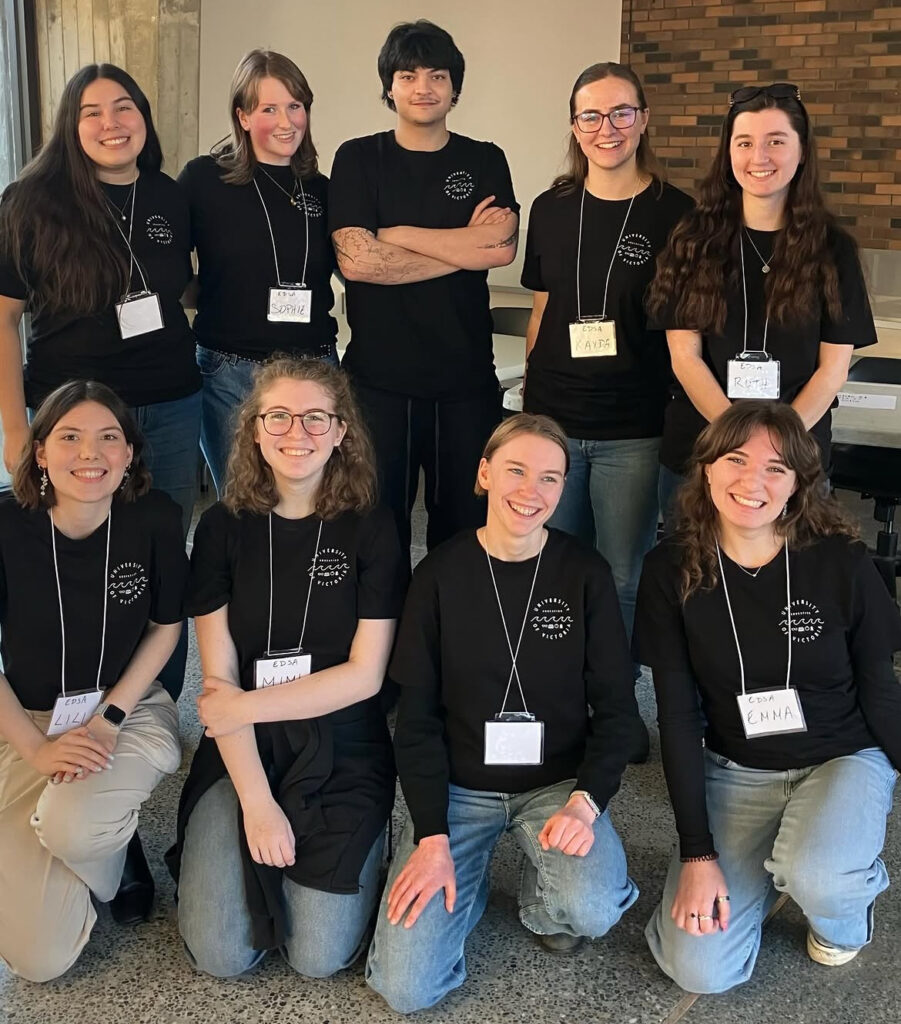
2026-2027 EdSA Executive team (I’m the bottom right)! Photo credit: @UVicEdSA on Instagram

A learning outcome of my PLN is to learn from others around me to become a better educator. I want to be inclusive, kind, passionate, and a good teacher. However, as Dr Shelley Moore reminds me, the want to be inclusive is not enough, as she notes that she has “never stepped into a school whose mission statement values segregation and exclusion, [but has] seen, in many schools, students experiencing all of exclusion, segregation, integration, and inclusion depending on the day, time, teacher, support staff, subject area, and grade” (Moore, 2016, p. 17). This reminds me that inclusion is an active task, where “100% of the time we are striving to be more inclusive” (Moore, 2016, p. 33).

One of the greatest way I expand my PLN to meet this goal is through my work at UVic’s Education Student Association (EdSA) where I have been an executive member for three years. Working on EdSA has allowed me to connect with faculty, students, and teachers/psychologists in the local community to further build my pedagogical knowledge. As Dr Shelley Moore notes that her understanding of inclusion is continously expanding, I remind myself that diversifying my PLN is a lifelong task that will allow me to create inclusive learning environments for my future students (Moore, 2025, “Inclusion is Not Assimilation”).

Evolution of Thinking; re: Inclusion and PLN

After reading, watching, and reflecting on the material this week, I have come to see my PLN as less of a collection of people I know, and more of the values and philosophies I reflect, showing what biases may impact my future teaching. The use of social media and digital platforms have transformed the way educators all across the world can share resources, lesson plans, and learn from people they would have never had the opportunity to connect with otherwise. Whether this happens through Instagram reels, LinkedIn, or Discord, it allows for collaboration, and therefore further opportunities to challenge one’s previous biases, supporting inclusion and equity in the classroom.

Simultaneously, social media challenges communications due to the capitalistic greed of social algorithms, designed to keep you engaged and doom-scrolling forever. Developers want to keep you on their app, and they’ll do whatever it takes: even if that means changing your algorithm to encompass only extreme takes and controversial content. Marginalized voices and smaller creators are tossed to the side in favour of viral videos.

From an objective standpoint, social media is designed to be inclusive: it connects people from all walks of life, all around the world, allowing everyone to use the internet how they prefer. However, with anonymity comes negativity, with users often turning to harrassment like racism, sexism, and homophobia on any post that’s not by a cis white man. So, subjectively, I think social media is rather exclusive, favouring the oppressors, and lacking the necessary tools to ensure users cannot be terrible people just because they’re behind a screen. While employers look for and expect their employees to be respectful online, the truth is that hateful people will be hateful, and too many users have fake, no-profile picture accounts to disconnect themselves from their real life online.

Before this, I have never really considered whether or not the people I surround myself by and learn from amplifies the view of others. I think of myself more like a sponge, absorbing information from every facet around me, but never quite creating content to amplify marginalized voices. For example, I am passionately anti-genocide and occupation (as you’d assume everyone would be…) and thus am very pro-Palestine, from spending time researching Palestinian culture and circumstances to attending Palestine protests in both Victoria and Quebec. However, I have never used online platforms to share my research, protest information, or anything pro-Palestine. I write this off as my use of social media being a collage of my life, but I think, moving forward, I could be a lot more intentional with amplifying voices.

In sum, a diverse and inclusive PLN ensures that we are continously learning, instead of hitting a stalemate echo chamber where everyone around us shares the same thought process. As a future educator, connecting with others within the teaching community allows me to learn from a variety of teaching styles, philosophies, and cultures, creating a more inclusive and equitable environment for my students, and making me a better teacher!

How Technology is Changing Literacy

07/08/25

Today, I explored the article Connected Reading: A framework for understanding how adolescents encounter, evaluate, and engage with texts in the digital age by Turner, Hicks, and Zucker. This article really opened my eyes to how much reading has changed in the digital age. Originally a solitary activity, reading is now social and interactive. Literacy today is about sharing and collaborating, not just absorbing information. Based off of this, I made a haiku:

Readers as learners

Sharing thoughts, we read as one

Connected through text

I originally learned poetry and haiku-making in my grade 10 English class. We were tasked with collaborating as a class to make haikus, then as groups, partners, and eventually alone, and sharing them with each other. Thinking about this, and what I’ve read, I see how social connection through reading is just as important as comprehension.

The Adolescent Brain and Literacy

07/07/25

Today, I deepened my understanding of how powerful the adolescent brain is. Through watching a video and reading an article on neuroplasticity, and listening to a podcast about the importance of continuing to build on foundational skills during adolescence, I have realized that adolescence is one of the most important and flexible periods of development.

One question I posed, How might the quality of an adolescent’s relationships with peers shape their ability to adapt to future complex social environments? got me thinking about the long-term impacts of social dynamics during this stage of development. Supportive relationships don’t just help teenagers to “get through” high school, but actually affect how well they can handle social situations for the rest of their lives.

This makes me reflect on my own time in middle and high school, and how grateful I am that I had a couple groups of friends that stuck with me through thick and thin. In turn, it makes me proud that I was able to be supportive and a good friend to others during this time too.

Teenagers are not just a “behavioural problem to manage,” but kids that need support with learning, relationships, and resilience.

Windows Activator Software ✓ Activate Microsoft Windows & Office


Buy and Download Windows Activator Software for Instant Activation

If you want to quickly activate your Windows operating system, buying and downloading windows activator software is a simple and effective solution. This software helps users unlock all the features of their Windows without any hassle. With instant activation, you can enjoy a fully functional system right after installation. Using windows activator software ensures that your copy of Windows is genuine and ready to use, avoiding any limitations or interruptions.

Many people look for a reliable way to activate Windows without spending too much time or effort. Windows activator software offers a fast and easy method to achieve this. It works by validating your system and enabling all the premium features that come with a licensed version. This means you can access updates, security patches, and customization options without restrictions.

When you buy and download windows activator software, you get a tool designed to work with different versions of Windows. Whether you have Windows 7, 8, or 10, this software can help you activate your system smoothly. It is important to choose a trusted source to ensure the software is safe and effective. Using windows activator software not only saves time but also provides peace of mind knowing your system is properly activated.

How Windows Activator Software Works: Activation Methods and Key Features

Windows activator software is designed to help users activate their Windows operating system quickly and easily. This activation software for windows uses different software activation methods to verify and unlock the full features of the system. One common approach is digital license activation, which allows the system to be activated without needing a physical product key. Another method involves windows license activation that connects the system to Microsoft’s servers to confirm the license status.

Using windows activator software simplifies the activation process by automating these steps. It ensures that the Windows copy is genuine and fully functional. This software can work with various Windows versions, making it a versatile tool for many users.

Understanding KMS Technology and Windows Activation Protocols

KMS (Key Management Service) technology is a popular software activation method used by windows activator software. It works by creating a local server that mimics Microsoft’s activation servers. This server communicates with the Windows system to perform windows license activation without needing to connect to the internet.

KMS technology follows specific Windows activation protocols to ensure the system is correctly activated. It sends activation requests and receives responses that confirm the license status. This method is often used in large organizations to activate multiple computers efficiently.

Feature Description
Local Server Mimics Microsoft activation servers
Activation Requests Sends and receives license status messages
Offline Activation Can activate without internet connection

Activation Without License Key and License Key Bypass Methods Explained

Some windows activator software uses activation methods that do not require a license key. These methods include digital license activation, where the system is activated based on hardware and software information stored in Microsoft’s database. This means users do not need to enter a product key manually.

License key bypass methods are techniques that allow activation without using a valid key. These methods modify system files or use special scripts to trick the Windows activation system. While these methods can activate Windows quickly, they may carry risks and are not always recommended.

“Activation without a license key can be convenient but may affect system security and updates.”

Key Features, Benefits, and Safety of Windows Activator Software

Windows activator software offers several key features that make it useful for users:

  • Supports multiple Windows versions
  • Provides instant activation
  • Uses digital license activation for ease
  • Offers windows license activation without manual key entry

The benefits include saving time, avoiding activation errors, and unlocking all Windows features. Safety is also important; trusted activator software ensures no harmful changes to the system and protects user data.

Benefits Description
Time-saving Quick activation process
User-friendly Easy to use with simple steps
Secure Protects system integrity
Compatible Works with various Windows editions

Windows Activation Utility Tools: Windows Activation Manager and Activation Toolkit

Windows activation utility tools like Windows Activation Manager and Activation Toolkit are part of the activation software for windows ecosystem. These tools help manage the activation process by providing user interfaces and automation features.

  • Windows Activation Manager: Simplifies windows license activation by guiding users through the steps and checking activation status.
  • Activation Toolkit: Offers advanced options for digital license activation and troubleshooting activation issues.

These utilities complement windows activator software by making activation easier and more reliable for users.

Installation and Setup Guide for Windows Activator Software

Installing activation software for Windows is a straightforward process that helps you unlock all the features of your operating system. Before starting, make sure you have a reliable activation software download ready. This guide will walk you through the steps to set up the software safely and correctly.

When you perform a windows activation tool download, it’s important to verify the file is complete and free from errors. After downloading, you usually need to run the installer and follow on-screen instructions. The setup process often includes accepting terms and selecting installation preferences.

Once installed, the activation software for Windows will prepare your system for activation by checking your current license status. This ensures the software works smoothly with your version of Windows, whether it’s Windows 7, 8, or 10.

Step-by-Step Installation of Windows Activation Software for Windows 10, 8, and 7

  1. Download the activation software download file from a trusted source.
  2. Locate the downloaded file in your Downloads folder or the chosen directory.
  3. Right-click the installer and select “Run as administrator” to start the setup.
  4. Follow the installation wizard by clicking “Next” and agreeing to the license terms.
  5. Choose the installation folder or use the default path suggested by the installer.
  6. Click “Install” and wait for the process to complete.
  7. Finish the setup by clicking “Finish” and restarting your computer if prompted.

How to Use Windows Activation Script and Activation Software for PC

After installation, you can use the windows activation tool download to activate your system. Most activation software for Windows includes a script or a simple interface to start the activation process.

  • Open the activation software.
  • Select the option to activate Windows.
  • The software will run a script that communicates with activation servers or emulates them.
  • Wait for the confirmation message that Windows is activated.
  • Restart your PC if required to apply changes.

Using the activation script is usually automatic, but some tools allow manual input of activation keys or additional settings for advanced users.

Downloading and Running Windows Activation Patch and Activation Crack

Sometimes, activation software for Windows comes with a patch or crack to bypass license checks. To use these safely:

  • Perform the activation software download from a secure source.
  • Extract the patch or crack files if they are compressed.
  • Run the patch as an administrator.
  • Follow any instructions to apply the crack to your Windows system.
  • Restart your computer to complete the activation.

Note: Using patches or cracks can carry risks and may affect system security or updates.

Emulating Local Server for Corporate Network Activation

In corporate environments, activation software for Windows may use a local server emulation to activate multiple PCs efficiently. This method mimics Microsoft’s activation servers within the company network.

  • The activation software sets up a local Key Management Service (KMS) server.
  • PCs connect to this local server to request activation.
  • The local server responds with activation approval without needing internet access.
  • This method saves bandwidth and simplifies managing many licenses.
Step Description
Setup Local Server Install KMS server software on a network PC
Configure Network Access Allow client PCs to connect to the server
Run Activation Tool Use activation software to connect to KMS
Verify Activation Status Check that all PCs show activated licenses

Frequently Asked Questions About Windows Activator Software

Windows activator software helps users unlock the full features of their Windows operating system. Many people have questions about how these tools work and their safety. Below are some common questions and answers about activation software for windows, windows activation utility, and software activation tool.

Using an activation software for windows can make the process easier by automating license verification. A windows activation utility often includes features to check activation status and guide users through activation steps. A software activation tool may support different Windows versions and activation methods.

Question Short Answer
Is activation software for windows safe? Usually yes, if downloaded from trusted sources
Can I activate Windows without a product key? Yes, some tools offer this feature
Does the software activation tool work for all Windows versions? Most support Windows 7, 8, 10, and 11
Can I use windows activation utility for Office products? Some tools support Office activation too

How to Activate Windows Without Product Key?

Activating Windows without a product key is possible using certain activation software for windows. These tools use digital license activation or emulate activation servers to unlock Windows features without entering a key.

To do this, you usually:

  • Download a trusted software activation tool.
  • Run the windows activation utility included.
  • Follow the instructions to activate Windows automatically.

This method is helpful if you lost your product key or want a quick activation. However, it is important to use safe and reliable tools to avoid security risks.

What Is the Windows 10 Activation Key and How to Use It?

The Windows 10 activation key is a unique code that proves your copy of Windows is genuine. It usually comes with your purchase or device.

To use it:

  1. Open the activation settings on your PC.
  2. Enter the Windows 10 activation key when prompted.
  3. The system will verify the key using a windows activation utility.
  4. Once verified, Windows will be fully activated.

Using a software activation tool can simplify this process by automatically detecting and applying the key if you have it saved.

How to Use Windows 11 Activation CMD for Activation?

Windows 11 activation can be done using Command Prompt (CMD) commands with the help of activation software for windows.

Steps include:

  • Open CMD as administrator.
  • Use specific commands to install the product key and activate Windows.
  • The windows activation utility may automate these commands for you.

This method is useful for advanced users who want to manually control the activation process using a software activation tool.

Is Windows Activator Software Free and Safe to Use?

Some windows activator software is free, while others require payment. Free tools can be helpful but may carry risks if not from trusted sources.

Safety tips:

  • Always download from reputable websites.
  • Use antivirus software to scan files.
  • Avoid tools that ask for personal information.

A reliable windows activation utility ensures your system stays secure while activating Windows.

“Using trusted activation software for windows protects your PC and ensures genuine Windows features.”

Can Windows Activator Software Work for Office Products?

Yes, some software activation tools are designed to activate Microsoft Office products as well as Windows.

Features include:

  • Detecting installed Office versions.
  • Applying activation keys or digital licenses.
  • Using windows activation utility functions to manage Office activation.

This makes it convenient to activate both Windows and Office with one tool, saving time and effort.

telegram indian porn Join 200+ Best Adult Channels Now ✓


Join the Best Indian Porn Telegram Groups for Adult Content

If you’re looking for exciting adult content, joining the best Indian porn Telegram groups is a great option. These groups offer a variety of content that caters to different tastes and preferences. You can find Indian adult channels that share videos, images, and discussions about adult themes.

Many of these groups are part of NSFW groups, which means they focus on not safe for work content. This can include everything from erotic stories to explicit videos. Indian adult groups are popular for their diverse content and active communities.

In addition to public groups, there are also private channels that offer exclusive content. These channels often require an invitation or approval to join, making them a bit more special. By joining these groups, you can connect with others who share similar interests and explore a wide range of adult content.

Nude Content Available in Telegram Groups

Telegram groups are a popular place for sharing nude content, especially among those interested in Indian content. These groups often host adult discussions where members can talk about their preferences and share experiences related to mature content.

Many users are drawn to these groups for the variety of Indian NSFW material available. You can find everything from images to videos that cater to different tastes.

What types of content are shared in Indian adult Telegram groups?

In Indian adult Telegram groups, you can expect to see a range of explicit content. Here’s a quick list of what you might find:

  • Adult Media: This includes videos and images that are meant for mature audiences.
  • Indian Media Sharing: Members often share local content that reflects Indian culture and themes.
  • Indian Video Sharing: Users post videos that may include adult themes or explicit material.

These groups provide a platform for sharing and discussing various forms of adult content, making them a hub for those interested in exploring this type of media.

Relevant Short Videos in Telegram Channels

Telegram channels are a great place to find relevant short videos, especially for those interested in the adult community. These channels often feature clips that are entertaining and cater to various tastes in adult entertainment.

Many users turn to Indian social media platforms to discover these short videos. The content shared here can range from funny clips to more explicit material, appealing to a wide audience.

Join us Telegram Porn Channels for exclusive content

If you’re looking to dive deeper into adult sharing, joining Indian private groups can be a fantastic option. These groups often focus on adult networking, allowing members to connect and share their favorite content.

Here’s a quick list of what you might find in these exclusive channels:

  • Short Adult Clips: Quick videos that are perfect for a brief entertainment break.
  • User-Generated Content: Members share their own creations, adding a personal touch.
  • Themed Video Collections: Curated lists of videos based on specific interests or themes.

By joining these channels, you can access a treasure trove of Indian digital content that keeps you engaged and entertained.

Searches Related to Indian Telegram Adult Content

When exploring Indian Telegram adult content, many users turn to various platforms for their needs. These searches often lead to vibrant adult forums and lively Indian online discussions.

People engage in adult messaging to connect with others who share similar interests. This interaction helps build a sense of community among users.

Individuals are welcome to the porn Telegram channel

In these channels, individuals can participate in adult group chats that foster open conversations.

The channels also promote Indian online sharing, allowing users to exchange content freely.

Here’s a quick list of what you might find in these adult platforms:

  • Adult Group Chats: Spaces for discussions and sharing experiences.
  • Indian Digital Sharing: Platforms for exchanging various types of adult content.
  • Community Engagement: Opportunities to connect with like-minded individuals.

These elements make Indian online communities a popular choice for those interested in adult content.

Desi Girls 18+ Content on Telegram

Desi girls 18+ content on Telegram is a popular topic among users looking for adult content. Many people join Indian adult channels to explore this type of material. These channels often feature a variety of content that caters to different preferences and interests.

In addition to videos and images, users can engage in adult discussions within these groups. This creates a lively environment where members can share their thoughts and experiences related to Indian adult content.

Above 18+ porn channels: What to look for

When searching for above 18+ porn channels, it’s important to know what to look for. Here are some key points to consider:

  • Private Channels: These channels often provide exclusive content that is not available in public groups.
  • Indian Content: Look for channels that focus on Indian themes and styles, as they often resonate more with local audiences.
  • Adult Discussions: Engage in conversations about preferences and experiences to enhance your understanding of the content.
  • Indian NSFW: Make sure the channels you join are labeled as NSFW to ensure you are accessing adult material.

By keeping these points in mind, you can find the best channels that suit your interests in adult content.

What Other Platforms Share Indian Adult Content?

There are several platforms where you can find Indian adult content. These platforms cater to different tastes and preferences, making it easier for users to explore mature content.

Some popular options include:

  • Adult Media Websites: These sites focus on sharing explicit videos and images, often featuring Indian themes.
  • Indian Media Sharing Platforms: Users can upload and share their own content, creating a diverse library of adult material.
  • Indian Video Sharing Sites: These platforms allow users to post videos that may include adult themes, making them a hub for adult entertainment.

Understanding the laws surrounding adult content in India

When it comes to adult content in India, it’s important to understand the laws that govern it. The legal landscape can be complex, especially on Indian social media and online groups.

Here are some key points to consider:

  • Adult Community Guidelines: Many platforms have specific rules about what can be shared, especially regarding explicit content.
  • Censorship Laws: The Indian government has regulations that restrict certain types of adult entertainment, impacting what can be shared online.
  • User Responsibility: Individuals should be aware of the laws and ensure they are sharing content responsibly within the adult community.

FAQ

In this section, we will answer some common questions about Telegram and adult content sharing.

Can police track Telegram?

Yes, police can track Telegram, but it depends on various factors. Telegram offers some privacy features, but if law enforcement has a reason to investigate, they can potentially access user data.

Is Telegram free in India?

Yes, Telegram is free to use in India. You can download the app and join groups without any cost. This makes it a popular choice for users looking to connect and share content.

Where can I find private Telegram channels?

You can find private Telegram channels by searching online forums or social media groups that focus on adult sharing. Many users share links to these channels, especially those related to Indian private groups.

How to find real Telegram groups?

To find real Telegram groups, you can use search engines or join adult networking forums. Look for recommendations from other users who share similar interests in Indian digital content.

© 2026 Emma's Archive

Theme by Anders NorenUp ↑